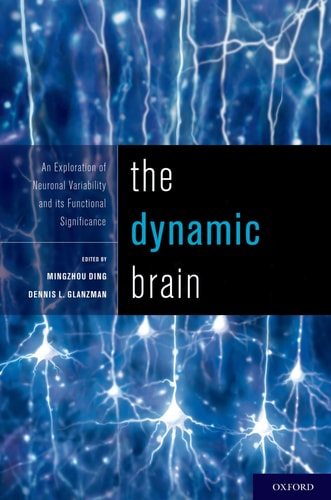
The Dynamic Brain: An Exploration of Neuronal Variability and Its Functional Significance
0
0
As an Amazon Associate and affiliate partner, Menrva Books earns from qualifying purchases. Learn more
Author Description
It is a well-known fact of neurophysiology that neuronal responses to identically presented stimuli are extremely variable. This variability has in the past often been regarded as "noise." At the single neuron level, interspike interval (ISI) histograms constructed during either spontaneous or stimulus evoked activity reveal a Poisson type distribution. These observations have been taken as evidence that neurons are intrinsically "noisy" in their firing properties. In fact, the use of averaging techniques, like post-stimulus time histograms (PSTH) or event-related potentials (ERPs) have largely been justified based on the presence of what was believed to be noise in the neuronal responses.More recent attempts to measure the information content of single neuron spike trains have revealed that a surprising amount of information can be coded in spike trains even in the presence of trial-to-trial variability. Multiple single unit recording experiments have suggested that variability formerly attributed to noise in single cell recordings may instead simply reflect system-wide changes in cellular response properties. These observations raise the possibility that, at least at the level of neuronal coding, the variability seen in single neuron responses may not simply reflect an underlying noisy process. They further raise the very distinct possibility that noise may in fact contain real, meaningful information which is available for the nervous system in information processing.To understand how neurons work in concert to bring about coherent behavior and its breakdown in disease, neuroscientists now routinely record simultaneously from hundreds of different neurons and from different brain areas, and then attempt to evaluate the network activities by computing various interdependence measures, including cross correlation, phase synchronization and spectral coherence. This book examines neuronal variability from theoretical, experimental and clinical perspectives.
Menrva's Summary
THE THESIS
This book investigates whether the inherent variability in neuronal firing patterns, traditionally dismissed as noise, functions as a meaningful component of neural information processing. Authors Dennis Glanzman and Mingzhou Ding synthesize neurophysiological data to challenge the long-standing assumption that trial-to-trial fluctuations in spike trains are merely stochastic errors. By examining the shift from single-neuron analysis to network-level interdependence measures, the text argues that this variability may be a fundamental mechanism for coherent brain function and a key indicator in understanding neurological disease states.
THE SCOPE MAP
What You Will Find
- Theoretical frameworks for interpreting neuronal variability beyond stochastic noise models.
- Methodologies for evaluating network activity, including cross correlation, phase synchronization, and spectral coherence.
- Experimental evidence derived from multiple single-unit recording techniques.
- Clinical perspectives on how neuronal variability relates to coherent behavior and the breakdown of neural systems in disease.
THE AUTHORITY PERSPECTIVE
Experts identify this work as a significant synthesis for researchers seeking to move beyond traditional averaging techniques like PSTH or ERPs. Readers frequently note the technical density of the prose, which is intended for an audience of neuroscientists and advanced students in the field of computational neuroscience.
Page Count:
392
Publication Date:
2011-01-18
Publisher:
Oxford University Press
ISBN-10:
0195393791
ISBN-13:
9780195393798
Psychology
Science
Psychometrics
Neuroscience
Neurons
Biology
Medical
Brain
Community Tags
Similar Books









Reader Comments
Share Your Thoughts
No comments yet. Be the first to share your thoughts!