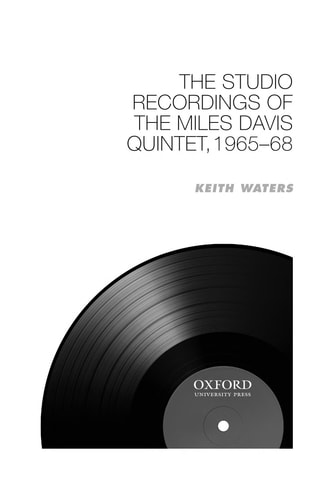
The Studio Recordings of the Miles Davis Quintet, 1965-68
0
0
As an Amazon Associate and affiliate partner, Menrva Books earns from qualifying purchases. Learn more
Author Description
The "Second Quintet" -- the Miles Davis Quintet of the mid-1960s -- was one of the most innovative and influential groups in the history of the genre. Each of the musicians who performed with Davis--saxophonist Wayne Shorter, pianist Herbie Hancock, bassist Ron Carter, and drummer Tony Williams--went on to a successful career as a top player. The studio recordings released by this group made profound contributions to improvisational strategies, jazz composition, and mediation between mainstream and avant-garde jazz, yet most critical attention has focused instead on live performances or the socio-cultural context of the work. Keith Waters' The Studio Recordings of the Miles Davis Quintet, 1965-68 concentrates instead on the music itself, as written, performed, and recorded.Treating six different studio recordings in depth--ESP, Miles Smiles, Sorcerer, Nefertiti, Miles in the Sky, and Filles de Kilimanjaro--Waters has tracked down a host of references to and explications of Davis' work. His analysis takes into account contemporary reviews of the recordings, interviews with the five musicians, and relevant larger-scale cultural studies of the era, as well as two previously unexplored sources: the studio outtakes and Wayne Shorter's Library of Congress composition deposits. Only recently made available, the outtakes throw the master takes into relief, revealing how the musicians and producer organized and edited the material to craft a unified artistic statement for each of these albums. The author's research into the Shorter archives proves to be of even broader significance and interest, as Waters is able now to demonstrate the composer's original conception of a given piece. Waters also points out errors in the notated versions of the canonical songs as they often appear in the main sources available to musicians and scholars. An indispensible resource, The Miles Davis Quintet Studio Recordings: 1965-1968 is suited for the jazz scholar as well as for jazz musicians
Menrva's Summary
THE THESIS
How did the studio recordings of the Miles Davis Quintet between 1965 and 1968 redefine improvisational strategies and jazz composition? Keith Waters, a music theorist and scholar, utilizes a rigorous analytical framework to examine the technical and creative output of the "Second Quintet." By synthesizing contemporary reviews, musician interviews, and previously unexamined studio outtakes and composition deposits, Waters argues that the studio process itself was a deliberate act of artistic construction that warrants closer scrutiny than the group's live performances.
THE SCOPE MAP
What You Will Find
- Detailed musicological analysis of six studio albums: ESP, Miles Smiles, Sorcerer, Nefertiti, Miles in the Sky, and Filles de Kilimanjaro.
- Examination of Wayne Shorter's original composition deposits from the Library of Congress.
- Comparative study of studio outtakes versus master takes to reveal editing and organizational techniques.
- Correction of errors found in standard notated versions of canonical jazz compositions.
THE AUTHORITY PERSPECTIVE
Experts and music scholars identify this work as a foundational text for understanding the technical evolution of mid-1960s jazz. Readers frequently note the academic density of the prose, which is specifically tailored for jazz musicians and musicologists seeking a granular look at the quintet's recording process.
Page Count:
320
Publication Date:
2011-03-15
Publisher:
Oxford University Press
ISBN-10:
019539383X
ISBN-13:
9780195393835
Music
Biography
Jazz
Music american
Music theory
Academic
Music History
Community Tags
Other Editions(5)




Similar Books










Reader Comments
Share Your Thoughts
No comments yet. Be the first to share your thoughts!