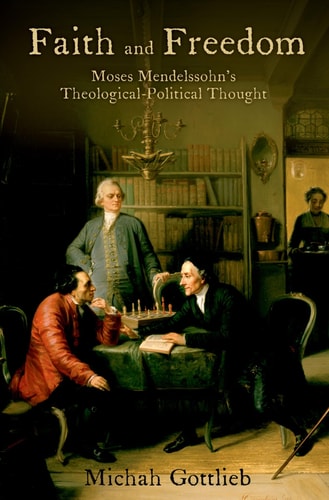
Faith and Freedom: Moses Mendelssohn's Theological-Political Thought
0
0
As an Amazon Associate and affiliate partner, Menrva Books earns from qualifying purchases. Learn more
Author Description
The recent renewal of the faith-reason debate has focused attention on earlier episodes in its history. One of its memorable highlights occurred during the Enlightenment, with the outbreak of the "Pantheism Controversy" between the eighteenth century Jewish philosopher Moses Mendelssohn and the Christian Counter-Enlightenment thinker Friedrich Heinrich Jacobi. While Mendelssohn argued that reason confirmed belief in a providential God and in an immortal soul, Jacobi claimed that its consistent application led ineluctably to atheism and fatalism. At present, there are two leading interpretations of Moses Mendelssohn's thought. One casts him as a Jewish traditionalist who draws on German philosophy to support his premodern Jewish beliefs, while the other portrays him as a secret Deist who seeks to encourage his fellow Jews to integrate into German society and so disingenuously defends Judaism to avoid arousing their opposition. By exploring the Pantheism Controversy and Mendelssohn's relation to his two greatest Jewish philosophical predecessors, the medieval Rabbi Moses Maimonides and the seventeenth century heretic Baruch Spinoza, Michah Gottlieb presents a new reading of Mendelssohn arguing that he defends Jewish religious concepts sincerely, but gives them a humanistic interpretation appropriate to life in a free, diverse modern society. Gottlieb argues that the faith-reason debate is best understood not primarily as an argument about metaphysical questions, such as whether or not God exists, but rather as a contest between two competing conceptions of human dignity and freedom. Mendelssohn, Gottlieb contends, gives expression to a humanistic religious perspective worthy of renewed consideration today.
Menrva's Summary
THE THESIS
Does the historical debate between faith and reason fundamentally concern metaphysical truth, or is it a contest over the nature of human dignity and freedom? Michah Gottlieb, a scholar of Jewish philosophy, examines the eighteenth-century Pantheism Controversy to re-evaluate the work of Moses Mendelssohn. By analyzing Mendelssohn's engagement with Maimonides and Spinoza, Gottlieb argues that Mendelssohn offered a sincere, humanistic defense of Judaism designed to foster religious life within a modern, pluralistic society.
THE SCOPE MAP
What You Will Find
- An analysis of the Pantheism Controversy between Moses Mendelssohn and Friedrich Heinrich Jacobi.
- A comparative study of Mendelssohn's philosophy alongside the works of Maimonides and Spinoza.
- A re-examination of the intersection between Enlightenment-era theology and political theory.
- A framework for understanding religious belief as a component of humanistic dignity rather than mere metaphysical dogma.
THE AUTHORITY PERSPECTIVE
Scholars recognize this work as a significant intervention in the study of Enlightenment-era Jewish philosophy, particularly for its departure from binary interpretations of Mendelssohn as either a traditionalist or a secret Deist. The text is noted for its rigorous engagement with primary sources and its ability to bridge the gap between historical theological debates and contemporary political discourse.
Page Count:
224
Publication Date:
2011-03-02
Publisher:
Oxford University Press
ISBN-10:
0195398947
ISBN-13:
9780195398946
History
Philosophy
Religion
Theology
Enlightenment
Jewish philosophy
Faith and reason
Jewish Studies
Judaism and philosophy
Judaism
Community Tags
Similar Books