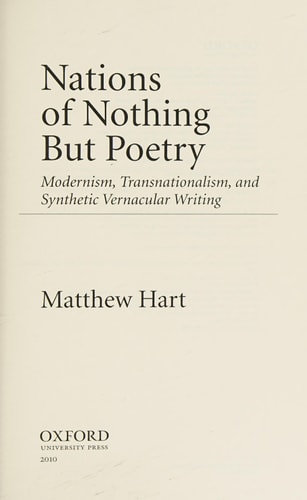
Nations of Nothing But Poetry: Modernism, Transnationalism, and Synthetic Vernacular Writing
0
0
As an Amazon Associate and affiliate partner, Menrva Books earns from qualifying purchases. Learn more
Author Description
Modernism is typically associated with novelty and urbanity. So what happens when poets identify small communities and local languages with the spirit of transnational modernity? Are vernacular poetries inherently provincial or implicitly xenophobic? How did modernist poets use vernacular language to re-imagine the relations between people, their languages, and the communities in which they live?Nations of Nothing But Poetry answers these questions through case studies of British, Caribbean, and American poetries from the 1920s through the 1990s. With a combination of fresh insights and attentive close readings, Matthew Hart presents a new theory of a "synthetic vernacular"-writing that explores the aesthetic and ideological tensions within modernism's dual commitments to the local and the global. The result is an invigorating contribution to the field of transnational modernist studies. Chapters focus on a mixture of canonical and non-canonical writers, combining new literary histories--such as the story of how Melvin B. Tolson, while a resident of Oklahoma, was appointed Poet Laureate of Liberia--with analyses of poems by Gertrude Stein, W. H. Auden, Ezra Pound, and T. S. Eliot.More broadly, the book reveals how the language of modernist poetry was shaped by the incompletely globalized nature of a world in which the nation-state continued to be a primary mediator of cultural and political identity, even as its authority was challenged as never before. Through deft juxtaposition, Hart develops a new interpretation of modernist poetry in English-one that disrupts the critical opposition between nationalism and the transnational, paving the way for a political history of modernist cosmopolitanism.
Menrva's Summary
THE THESIS
This book investigates how modernist poets utilized a 'synthetic vernacular' to navigate the ideological tensions between local identity and global transnationalism. Matthew Hart, a scholar of modernist literature, examines the intersection of language, nationhood, and community across the 20th century. By analyzing the work of both canonical and non-canonical poets, he argues that the nation-state remained a critical mediator of identity even as modernist writers sought to transcend traditional borders.
THE SCOPE MAP
What You Will Find
- Case studies of British, Caribbean, and American poetry spanning the 1920s to the 1990s.
- A theoretical framework defining 'synthetic vernacular' as a tool for aesthetic and political expression.
- Close readings of major figures including Gertrude Stein, W. H. Auden, Ezra Pound, and T. S. Eliot.
- Historical analysis of the cultural and political role of the nation-state in shaping poetic language.
THE AUTHORITY PERSPECTIVE
Scholars recognize this work as a significant contribution to the study of transnational modernism and the political history of cosmopolitanism. Readers frequently note the academic rigor and the depth of the author's archival research into both well-known and overlooked literary histories.
Page Count:
256
Publication Date:
2010-04-22
Publisher:
Oxford University Press
ISBN-10:
0195390334
ISBN-13:
9780195390339
Poetry
Transnationalism
Modernism
Kindle eBooks
Literary Criticism
European
World Literature
Categories
Criticism & Theory
Kindle Store
Community Tags
Similar Books