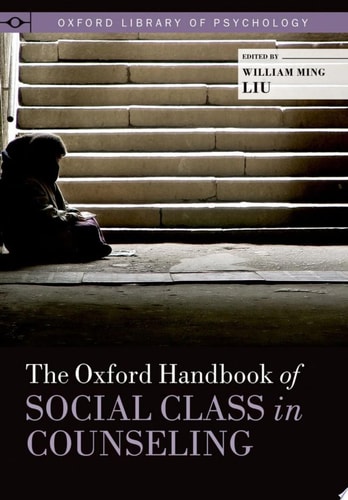
The Oxford Handbook of Social Class in Counseling
0
0
As an Amazon Associate and affiliate partner, Menrva Books earns from qualifying purchases. Learn more
Author Description
Social class is a pervasive facet of all lives, regardless of one's own social class and status. One would think its ubiquity would make it necessary for all helping professionals to understand social class and discuss it in therapy and research. Yet social class and classism are one of the most confusing and difficult concepts to understand and integrate into research and counseling practice--mostly due to the relative lack of psychological theories, research, and quantitative data.Fulfiling this need, this handbook summarizes and synthesizes available research on social class and classism in counseling practice and research areas. The 32 chapters included offer up-to-date, fascinating, and provocative applications of social class and classism, as seasoned chapter authors provide an overview of theories related to social class and classism and its application toward research, education, training, and practice. Chapters include comprehensive coverage of:- lifespan issues related to social class, such as unique aspects of social class and classism in the lives of children, adolescents, and older adults- how social class is studied and empirically understood through research, assessment, and practice- implications of social class in career counseling, psychological assessment and diagnosis, and the therapy relationship- how social class is implicated in positive psychology, career and work psychology, and health psychology- social class and classism and its connection to whiteness, racism, sexual orientation, religion and spirituality, and social justiceThis book offers the first compendium of counseling related resources on social class and classism and will be a comprehensive, must-have reference for professionals and academics in counseling psychology and related fields for years to come.
Menrva's Summary
THE THESIS
This handbook investigates the pervasive yet under-researched influence of social class and classism within the fields of counseling psychology and clinical practice. William Ming Liu, a prominent scholar in the field, compiles contributions from various experts to address the theoretical and empirical gaps surrounding socioeconomic status. The text provides a structured framework for integrating class-based awareness into research, education, and therapeutic interventions, aiming to standardize how helping professionals conceptualize these dynamics.
THE SCOPE MAP
What You Will Find
- Comprehensive analysis of lifespan development as it relates to social class and classism.
- Methodological approaches for studying and assessing social class in empirical research.
- Practical applications for career counseling, psychological diagnosis, and the therapeutic alliance.
- Intersectional explorations connecting classism to race, sexual orientation, and social justice.
THE AUTHORITY PERSPECTIVE
Experts and academics recognize this volume as a foundational reference for integrating socioeconomic factors into psychological training and clinical practice. Readers frequently note the academic density of the prose, which serves as a primary resource for professionals seeking to address systemic class issues in mental health settings.
Page Count:
586
Publication Date:
2013-03-28
Publisher:
Oxford University Press
ISBN-10:
0195398254
ISBN-13:
9780195398250
Psychology
Social Science
Psychotherapy
Counseling
Social Classes
Reference
Sociology
Community Tags
Other Editions(3)
Similar Books








Reader Comments
Share Your Thoughts
No comments yet. Be the first to share your thoughts!