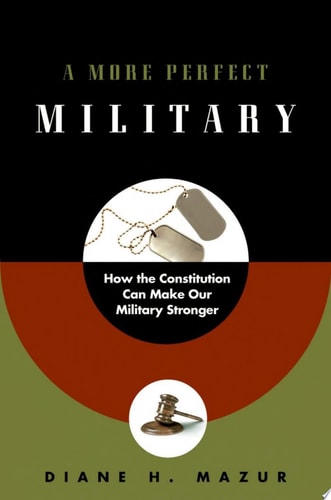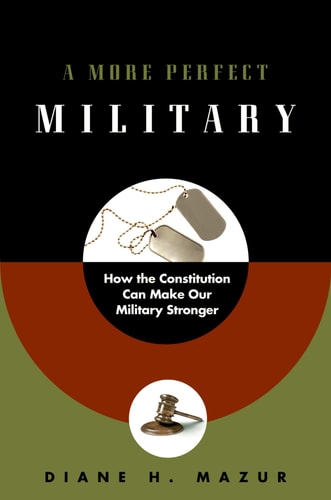
A More Perfect Military: How the Constitution Can Make Our Military Stronger
0
0
As an Amazon Associate and affiliate partner, Menrva Books earns from qualifying purchases. Learn more
Author Description
Surveys show that the all-volunteer military is our most respected and trusted institution, but over the last thirty-five years it has grown estranged from civilian society. Without a draft, imperfect as it was, the military is no longer as representative of civilian society. Fewer people accept the obligation for military service, and a larger number lack the knowledge to be engaged participants in civilian control of the military.The end of the draft, however, is not the most important reason we have a significant civil-military gap today. A More Perfect Military explains how the Supreme Court used the cultural division of the Vietnam era to change the nature of our civil-military relations. The Supreme Court describes itself as a strong supporter of the military and its distinctive culture, but in the all-volunteer era, its decisions have consistently undermined the military's traditional relationship to law and the Constitution. Most people would never suspect there was anything wrong, but our civil-military relations are now as constitutionally fragile as they have ever been.A More Perfect Military is a bracingly candid assessment of the military's constitutional health. It crosses ideological and political boundaries and is challenging-even unsettling-to both liberal and conservative views. It is written for those who believe the military may be slipping away from our common national experience. This book is the blueprint for a new national conversation about military service.
Menrva's Summary
THE THESIS
This book investigates the constitutional fragility of modern American civil-military relations and argues that judicial overreach has alienated the military from civilian society. Diane H. Mazur, a former Air Force officer and law professor, utilizes her dual expertise to examine how Supreme Court decisions since the Vietnam era have fundamentally altered the legal status of the armed forces. She posits that the transition to an all-volunteer force, combined with specific judicial rulings, has created a dangerous disconnect between military culture and constitutional law. The work serves as a critical analysis of how current legal frameworks undermine the principle of civilian control.
THE SCOPE MAP
What You Will Find
- Analysis of Supreme Court jurisprudence regarding military law and civil-military relations.
- Historical examination of the transition from the draft to an all-volunteer military force.
- Evaluation of the cultural and legal estrangement between the military and civilian society.
- A proposed framework for re-engaging the public in the oversight and understanding of military service.
THE AUTHORITY PERSPECTIVE
Experts and legal scholars recognize this work as a provocative contribution to the study of civil-military relations. Readers frequently note the dense, analytical nature of the prose, which challenges conventional assumptions held by both liberal and conservative political factions.
Page Count:
240
Publication Date:
2010-11-17
Publisher:
Oxford University Press
ISBN-10:
0195394488
ISBN-13:
9780195394481
Politics
History
Civil-military relations
Professional Career & Trade
Law
Military Law
Government
Military
Community Tags
Similar Books