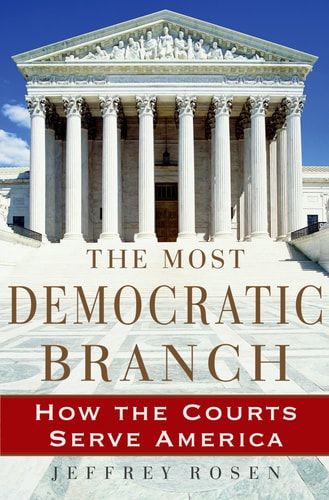
The Most Democratic Branch: How the Courts Serve America
0
0
As an Amazon Associate and affiliate partner, Menrva Books earns from qualifying purchases. Learn more
Author Description
Many critics attack federal judges as anti-democratic elitists, activists out of step with the mainstream of American thought. But others argue that judges should stand alone as the ultimate guardians of American values, placing principle before the views of the people.In The Most Democratic Branch, Jeffrey Rosen disagrees with both assertions. Contrary to what interest groups may claim, he contends that, from the days of John Marshall right up to the present, the federal courts by and large have reflected the opinions of the mainstream. More important, he argues that the Supreme Court is most successful when it defers to the constitutional views of the American people, as represented most notably by Congress and the Presidency. And on the rare occasion when they departed from the consensus, the result has often been a disaster.To illustrate, Rosen provides a penetrating look at some of the most important Supreme Court cases in American history--cases involving racial equality, affirmative action, abortion, gay rights and gay marriage, the right to die, electoral disputes, and civil liberties in wartime. Rosen shows that the most notorious constitutional decisions in American history--the ones that have been most strenuously criticized, such as Dred Scott or Roe v. Wade--have gone against mainstream opinion. By contrast, the most successful decisions--from Marbury v. Madison to Brown v. Board of Education--have avoided imposing constitutional principles over the wishes of the people. Rosen concludes that the judiciary works best when it identifies the constitutional principles accepted by a majority of Americans, and enforces them unequivocally as fundamental law.Jeffrey Rosen is one of the most respected legal experts writing today, a regular contributor to The New York Times Magazine and the Legal Affairs Editor of The New Republic. The provocative arguments that he puts forth here are bound to fuel heated debate at a time when the federal judiciary is already the
Menrva's Summary
THE THESIS
Does the federal judiciary function most effectively when it acts as an independent check on the public, or when it aligns its decisions with the constitutional consensus of the American people? Jeffrey Rosen, a legal scholar and frequent contributor to major political publications, argues that the Supreme Court historically succeeds only when it mirrors mainstream public opinion. He posits that judicial overreach occurs when courts attempt to impose principles that lack broad societal support, suggesting that the judiciary is most democratic when it interprets the law in harmony with the legislative and executive branches.
THE SCOPE MAP
What You Will Find
- Historical analysis of landmark Supreme Court cases including Dred Scott, Roe v. Wade, and Brown v. Board of Education.
- A framework for evaluating judicial legitimacy based on public consensus versus constitutional principle.
- Examination of the relationship between the judiciary, Congress, and the Presidency in shaping American law.
- Case studies on sensitive topics such as racial equality, civil liberties in wartime, and electoral disputes.
THE AUTHORITY PERSPECTIVE
Legal scholars and political commentators frequently cite this work as a significant contribution to the debate over judicial activism and democratic legitimacy. Readers often note the clarity of Rosen's prose, which makes complex constitutional theory accessible to those outside the legal profession.
Page Count:
256
Publication Date:
2006-06-19
Publisher:
Oxford University Press
ISBN-10:
0195174437
ISBN-13:
9780195174434
History
Politics
Supreme Court
Courts
Law
American Government
Government
Judges
United States
Professional Career & Trade
Community Tags
Other Editions(2)
Similar Books



Reader Comments
Share Your Thoughts
No comments yet. Be the first to share your thoughts!