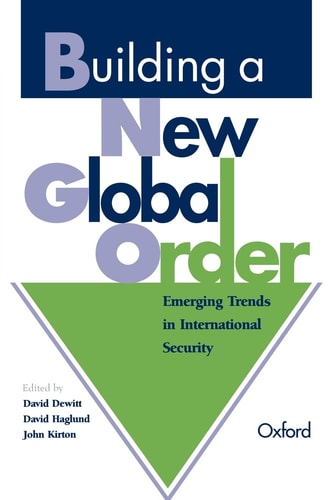
Building a New Global Order: Emerging Trends in International Security
0
0
As an Amazon Associate and affiliate partner, Menrva Books earns from qualifying purchases. Learn more
Author Description
The end of the Cold War era has not brought greater security to the world community. Although the likelihood of a global strategic nuclear war has been reduced significantly, we have already witnessed the impact of other challenges to international peace. As the Gulf War of 1991 demonstrated, regional conflicts can expand, adopting the methods and means of the earlier superpower confrontation. Recent events in the Horn of Africa, the Balkans, and Southeast Asia have revealed the continuing power of historic ethnic, religious, and national rivalries and the seeming inability of the international community to find effective solutions. At the same time, modern weapons and communications technologies, demographic changes and environmental degradation, vast disparities in wealth, and the globalization of both economic activity and Western culture pose enormous challenges. Are the international institutions with which we have lived since the end of the Second World War equipped to handle these problems? Written by international authorities in a wide range of disciplines, the essays in this text examine what is known, what must be determined, and what might be done with respect to these profound and urgent issues.
Menrva's Summary
THE THESIS
This text investigates whether post-World War II international institutions possess the capacity to address the complex, multifaceted security challenges emerging in the post-Cold War era. The authors, a collection of international authorities across various disciplines, analyze how regional conflicts, technological shifts, and economic globalization have rendered traditional security frameworks insufficient. By synthesizing historical context with contemporary geopolitical data, the contributors argue that current global structures require significant adaptation to manage modern threats effectively.
THE SCOPE MAP
What You Will Find
- Analysis of regional conflicts in the Balkans, the Horn of Africa, and Southeast Asia.
- Examination of the impact of modern communications and weapons technology on global stability.
- Evaluation of the efficacy of international institutions established after 1945.
- Discussion on the role of environmental degradation and economic disparities in international security.
THE AUTHORITY PERSPECTIVE
Experts recognize this work as a significant academic contribution to the study of post-Cold War geopolitical transitions. Readers frequently note the scholarly density of the essays, which provide a comprehensive framework for understanding the shift from superpower confrontation to decentralized global instability.
Page Count:
440
Publication Date:
1994-06-09
Publisher:
Oxford University Press
ISBN-10:
0195409647
ISBN-13:
9780195409642
History
Globalization
Security Studies
International relations
Community Tags
Similar Books