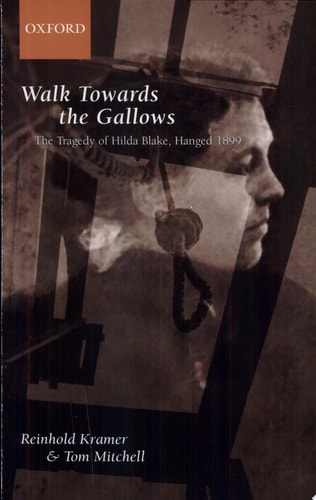
Walk Towards the Gallows: The Tragedy of Hilda Blake, Hanged 1899
0
0
As an Amazon Associate and affiliate partner, Menrva Books earns from qualifying purchases. Learn more
Author Description
On 5 July 1899 Hilda Blake, a 21-year-old maidservant in Brandon, Manitoba, who had come to Canada from England ten years earlier as an orphan immigrant, shot and killed her mistress. Two days after Christmas she was hanged, one of the few women in Canadian history to die for her crime.Blake unintentionally left a remarkable documentary record, ranging from Poorhouse records, courts dockets of custody and criminal cases in which she was the central figure, popular, journalistic, and professional assessments of her character, and a poem, 'My Downfall', that she penned in Brandon Gaol while awaiting execution. To explain why Hilda bought a gun and why she fired it, Kramer and Mitchell employee both historical and literary techniques. The result is a richly textured story of late Victorian social, cultural, and political life.This remarkable book – part mystery, part historical detective story – uncovers Hilda Blake's life, from her origins in Norfolk, England, to her tragic death. It also examines the lives of other principals in the story: successful Brandon businessman Robert Lane and his wife Mary, the murdered woman; Lane's business partner, Alexander McIlvride; Police Chief James Kircaldy; A.P. Stewart and his wife, Letitia Singer Stewart, the family for whom the 12-year-old orphaned Hilda first worked as a domestic servant; Rev. C.C. McLaurin, the Baptist minister who knew Hilda and counselled the condemned woman in her final days; social purity activist Dr Amelia Yeomans, who petitioned for clemency; Governor-General Minto, who urged the Laurier government to stay the execution, even Clifford Sifton, the MP from Brandon, federal minister of Immigration, and the most powerful western Liberal in the Laurier cabinet, for whom the case was a potential minefield.As the authors write, 'We tell a story because only a story can expose the real workings of a culture, and only a story can express our protest against time.'
Menrva's Summary
THE THESIS
This book investigates the social, cultural, and political factors that culminated in the 1899 execution of Hilda Blake, a young immigrant maidservant in Manitoba. Authors Reinhold Kramer and Tom Mitchell utilize a multidisciplinary approach, combining archival research with literary analysis to reconstruct the life and death of a woman who became a rare subject of capital punishment in Canadian history. By examining the documentary record—including court dockets, personal writings, and contemporary journalistic accounts—the authors argue that Blake's story serves as a lens through which to view the rigid hierarchies and moral anxieties of late Victorian society.
THE SCOPE MAP
What You Will Find
- A detailed reconstruction of the 1899 murder case in Brandon, Manitoba, and the subsequent legal proceedings.
- An analysis of the socio-economic conditions facing orphan immigrants in late 19th-century Canada.
- Extensive use of primary source materials, including Poorhouse records, court dockets, and the defendant's own poetry.
- Biographical profiles of the key figures involved, from local business elites to federal political actors like Clifford Sifton.
THE AUTHORITY PERSPECTIVE
Historians and scholars of Canadian social history recognize this work for its meticulous archival research and its ability to synthesize complex legal and cultural data into a coherent narrative. The text is frequently cited for its balanced examination of the intersection between individual tragedy and the broader political pressures of the Laurier era.
Page Count:
318
Publication Date:
2002-04-01
Publisher:
University of Toronto Press
ISBN-10:
0195416864
ISBN-13:
9780195416862
Biography
True Crime
History
Murder_canada
Social History
Murderers
Canadian History
Victorian Era
Community Tags
Similar Books