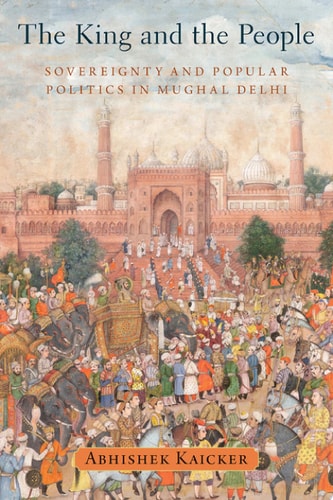
The King and the People: Sovereignty and Popular Politics in Mughal Delhi
0
0
As an Amazon Associate and affiliate partner, Menrva Books earns from qualifying purchases. Learn more
Author Description
An original exploration of the relationship between the Mughal emperor and his subjects in the space of the Mughal empire's capital, The King and the People overturns an axiomatic assumption in the history of premodern South Asia: that the urban masses were merely passive objects of rule and remained unable to express collective political aspirations until the coming of colonialism. Set in the Mughal capital of Shahjahanabad (Delhi) from its founding to Nadir Shah's devastating invasion of 1739, this book instead shows how the trends and events in the second half of the seventeenth century inadvertently set the stage for the emergence of the people as actors in a regime which saw them only as the ruled.Drawing on a wealth of sources from the seventeenth and eighteenth centuries, this book is the first comprehensive account of the dynamic relationship between ruling authority and its urban subjects in an era that until recently was seen as one of only decline. By placing ordinary people at the centre of its narrative, this wide-ranging work offers fresh perspectives on imperial sovereignty, on the rise of an urban culture of political satire, and on the place of the practices of faith in the work of everyday politics. It unveils a formerly invisible urban panorama of soldiers and poets, merchants and shoemakers, who lived and died in the shadow of the Red Fort during an era of both dizzying turmoil and heady possibilities.As much an account of politics and ideas as a history of the city and its people, this lively and lucid book will be equally of value for specialists, students, and lay readers interested in the lives and ambitions of the mass of ordinary inhabitants of India's historic capital three hundred years ago.
Menrva's Summary
THE THESIS
How did the urban masses of Mughal Delhi influence imperial sovereignty and political life during the seventeenth and eighteenth centuries? Abhishek Kaicker, a historian of early modern South Asia, challenges the traditional view that pre-colonial urban populations were passive subjects. By analyzing a wide array of primary sources, he argues that the residents of Shahjahanabad actively engaged in political discourse, satire, and public protest, thereby shaping the dynamics of the Mughal state long before the onset of British colonial rule.
THE SCOPE MAP
What You Will Find
- Analysis of political culture in Shahjahanabad from its founding to the 1739 invasion by Nadir Shah.
- Examination of urban political satire and its role in challenging imperial authority.
- Integration of diverse social groups, including soldiers, merchants, and artisans, into the historical narrative.
Scope Limits
- The study is geographically focused on the capital city of Shahjahanabad rather than the entirety of the Mughal Empire.
- The analysis concludes with the 1739 invasion, leaving the subsequent collapse of the empire largely outside the primary scope.
THE AUTHORITY PERSPECTIVE
Scholars recognize this work as a significant contribution to the historiography of the Mughal Empire, particularly for its focus on the agency of non-elite urban actors. Readers frequently note the accessibility of the prose despite the depth of the archival research presented.
Page Count:
376
Publication Date:
2020-03-02
Publisher:
Oxford University Press
ISBN-10:
0190070676
ISBN-13:
9780190070670
History
Massacres
Modern History
Educational Resources
Politics & Government
Social History
Special Topics
Asia
Urban History
New Used & Rental Textbooks
Mughal Empire
Political History
World
India
Asian History
Community Tags
Similar Books