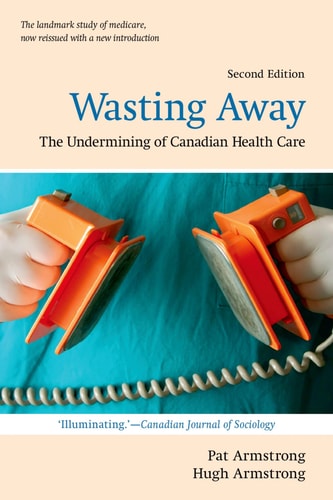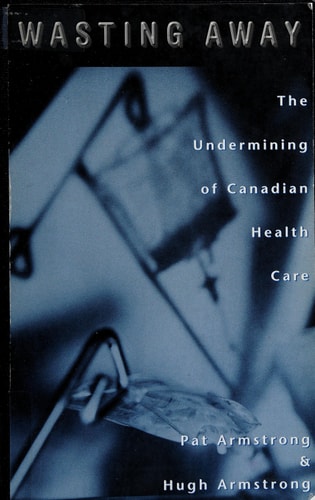
Wasting Away: The Undermining of Canadian Health Care
0
0
As an Amazon Associate and affiliate partner, Menrva Books earns from qualifying purchases. Learn more
Author Description
Canada's health care, which comprises a myriad of institutions and practices, is often referred to as Canada's best-loved social programme. This support is not surprising, given that it has been one of the most accessible health care systems in the world and has played a significant role in prolonging the life of many Canadians. In recent years, however, it has come under attack from a variety of sources. Every jurisdiction in the country has initiated far-ranging reforms aimed at reducing costs and has introduced strategies developed for lean and mean production in the private sector. This book will examine how most of these reforms fail to address the fundamental problems in the system. Many of the provincial reports justified cutbacks by agreeing with critics of the system that the focus should be on health, rather than illness, and that health is determined not only by individual lifestyles but also by social conditions. With such an approach, it could be argued that part of the solution to rising costs is prevention and another part is to send care, in the words of one report, "closer to home". Although there is talk of "client-oriented" care, total quality improvement, employee empowerment and community support, reform has primarily meant less of the same within institutions and more unpaid work for women in the home. The basic problems with institutional care remain largely untouched or even exaggerated while fewer and fewer people have access to good care.
Menrva's Summary
THE THESIS
This book investigates the systemic failure of recent Canadian health care reforms to address fundamental institutional problems while shifting the burden of care onto unpaid labor. Authors Hugh Armstrong and Pat Armstrong, both established scholars in sociology and political economy, utilize a critical analysis of provincial policy reports and institutional practices to argue that current cost-cutting measures prioritize private-sector efficiency models over genuine patient health. They contend that these reforms, often framed as 'client-oriented' or 'community-based,' ultimately reduce access to professional care and exacerbate social inequalities.
THE SCOPE MAP
What You Will Find
- Analysis of provincial health care reform strategies and their economic justifications.
- Critique of 'lean and mean' production models applied to public health institutions.
- Examination of the gendered impact of health care shifts, specifically the increase in unpaid domestic labor.
- Evaluation of the disconnect between rhetoric regarding 'health-focused' care and the reality of institutional cutbacks.
THE AUTHORITY PERSPECTIVE
Experts in Canadian public policy frequently cite this work as a critical counter-narrative to the prevailing discourse on health care privatization and efficiency. Readers often note the academic rigor of the authors' analysis, which provides a foundational perspective for understanding the socio-economic consequences of health system restructuring.
Page Count:
245
Publication Date:
1996-08-15
Publisher:
Oxford University Press
ISBN-10:
019541070X
ISBN-13:
9780195410709
Sociology
Health Care
Medical care
Public Policy