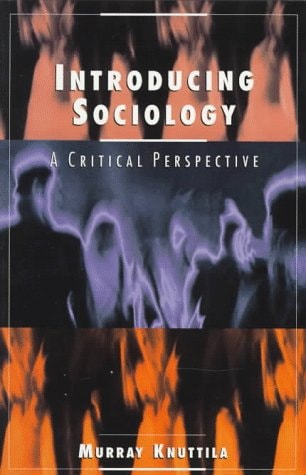
Introducing Sociology: A Critical Perspective
0
0
As an Amazon Associate and affiliate partner, Menrva Books earns from qualifying purchases. Learn more
Author Description
In this major revision of his earlier Sociology Revisited, Murray Knuttila examines the trends and theories in the discipline of sociology. Although each of these perspectives--structural functionalist, Marxist and neo-Marxist, symbolic interactionist--offers insights into understanding the human condition and society, none can provide satisfactory answers to all the questions that sociologists pose.Knuttila proposes an alternative approach--adapted from the work of British sociologist Anthony Giddens and infused with the philosophy of the American sociologist C.W. Mills-- that begins by examining the structure or organization of biological reproduction and material production within a society. As he notes, "most of the important new directions in sociological thinking and analysis during the past two decades have been stimulated and influenced by feminism", and recnet feminist studies on work and the family are of great significance to sociology today. Consequently, this new approach to social analysis draws on feminist theory and on materialist analysis.Introducing Sociology: A Critical Perspective introduces students to the basic principles of the sociological perspective and to the basic concepts and language of sociology, as well as to "the promise" of the sociological imagination as laid out by C.W. Mills. Knuttila writes: "to understand ourselves, we must be capable of answering questions that draw our attention to the impact of the social environment on ourselves and others." To illustrate the nature of social analysis, Knuttila focuses on the issues of social inequality, political power, deviance, and familial relations.
Menrva's Summary
THE THESIS
This text investigates the core question of how diverse sociological theories can be synthesized into a cohesive, critical framework to better understand the human condition and social structures. Murray Knuttila, an established academic, draws upon the foundational work of Anthony Giddens and C. Wright Mills to challenge traditional disciplinary silos. By integrating materialist analysis with contemporary feminist theory, the author provides a methodology for examining how social environments shape individual and collective experiences. The book serves as a pedagogical tool for students to navigate the complexities of power, inequality, and social organization.
THE SCOPE MAP
What You Will Find
- A comparative analysis of structural functionalist, Marxist, and symbolic interactionist perspectives.
- An introduction to the sociological imagination as defined by C. Wright Mills.
- Application of feminist theory to modern studies of work and family dynamics.
- Methodological frameworks for analyzing social inequality, political power, and deviance.
THE AUTHORITY PERSPECTIVE
Experts and educators frequently cite this text as a foundational resource for undergraduate students seeking to understand the intersection of classical theory and modern social issues. Readers often note the clarity of the prose, which effectively bridges the gap between dense academic theory and practical social application.
Page Count:
310
Publication Date:
1996-06-27
Publisher:
Oxford University Press
ISBN-10:
0195412079
ISBN-13:
9780195412079
Academic
Feminist Theory
Social Science
Sociology
Community Tags
Similar Books