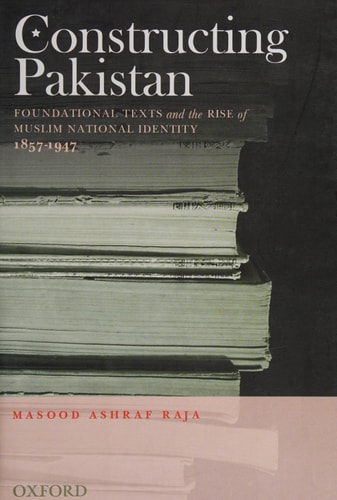
Constructing Pakistan: Foundational Texts and the Rise of Muslim National Identity, 1857-1947
0
0
As an Amazon Associate and affiliate partner, Menrva Books earns from qualifying purchases. Learn more
Author Description
Constructing Pakistan addresses the previously neglected aspect of postcolonial and historical engagement with the creation and construction of Indian Muslim national identity before the partition of India in 1947. Masood Ashraf Raja's main assertion, challenging the conventional and postcolonial appraisals of the Indian national history, is that the Indian Muslim particular identity and Muslim exceptionalism preceded the rise of Congress or Gandhian nationalism. Using major theories of nationalism-including works of Benedict Anderson, Anthony D. Smith, John Breuilly, Partha Chatterjee and others-and analysis of literary, political, and religious texts produced by Indian Muslims, Constructing Pakistan traces the varied Muslim responses to the post 1857 British ascendancy. This study provides a multilayered discussion of Indian Muslim nationalism from the rise of post 1857 Muslim exceptionalism to the beginnings of a more focused struggle for a nation-sate in the 1940s.In this dual act of retrieval and intervention, a varied mixture of literary, political, and religious texts are employed to suggest that if the Muslim textual production of this time period is read within the realm of politics and not just within the arena of culture, then the rise of Indian Muslim nationalism can be clearly traced within these texts and through their affective value for the Indian Muslims.Raja combines close readings of the texts, their reception, and the politics of identity formation specifically related to the rise of Indian Muslim nationalism. The author's main argument hinges on two important assumptions: 1) After the rebellion it becomes extremely important for the Muslim elite to force the dominant British regime into a hegemonic view of the Muslims, and 2) this forces the Muslim elite to develop a language of politics that must always invoke the people in order to enter the British system of privileges and dispensations. Consequently, the rise of early Muslim exceptionalism a
Menrva's Summary
THE THESIS
This work investigates the origins and development of Indian Muslim national identity between 1857 and 1947 by analyzing the foundational texts that shaped the movement for a separate nation-state. Masood Ashraf Raja, a scholar of postcolonial studies, utilizes a framework grounded in nationalism theories—including those of Benedict Anderson and Partha Chatterjee—to argue that Muslim exceptionalism was a distinct, proactive political force that predated Gandhian nationalism. By examining a diverse array of literary, political, and religious documents, the author demonstrates how the Muslim elite navigated British hegemony to construct a coherent national identity.
THE SCOPE MAP
What You Will Find
- Historical analysis of the period between the 1857 rebellion and the 1947 partition of India.
- Application of postcolonial and nationalism theories to primary source texts.
- Close readings of literary, political, and religious documents produced by the Indian Muslim elite.
- Examination of the strategic use of political language to secure privileges within the British colonial system.
THE AUTHORITY PERSPECTIVE
Scholars in the field of South Asian history and postcolonial studies recognize this text as a significant intervention in the study of Muslim identity formation. Readers frequently note the academic density of the prose and the author's rigorous application of theoretical frameworks to historical discourse.
Page Count:
182
Publication Date:
2010-06-28
Publisher:
Oxford University Press
ISBN-10:
0195478118
ISBN-13:
9780195478112
History
India
Muslims india
Nationalism
Community Tags
Similar Books