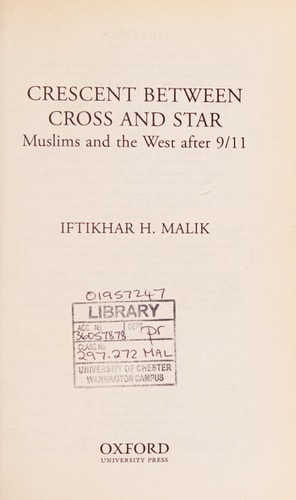
Crescent Between Cross and Star: Muslims and the West after 9/11
0
0
As an Amazon Associate and affiliate partner, Menrva Books earns from qualifying purchases. Learn more
Author Description
Misperceptions and reservations about Islam registered a significant impetus following the tragic events of 9/11 and 7/7. Against a backdrop of intense Islamophobia and neo-conservatism, military invasions of Muslim countries and restrictive legislation on immigration and civil liberties have seriously affected inter-community relationships, bringing the Muslim diaspora under serious scrutiny.Concurrently, scholars and journalists have portrayed Islam as a hegemonic ideology needing reformation. Polemicists and neo-orientalists have left no stone unturned in denigrating Islamic humanism. Diehard evangelists provide moral justification for this animus, which reverberates across the globe through similar groups such as Likud and Hindutva.While Muslims are overwhelmingly aggrieved over the destruction and denigration of their communities and heritage, their problems of poverty, universal disempowerment and alienation remain unattended by both their rulers and their Western backers, whose own interests take priority. Exposés of torture and brutalization of internees at Guantanamo Bay, Abu Ghraib Jail, Bagram Air Base and Israel's Facility 1391, and massacres such as those at Mazar-i-Sharif, Kandahar, Gujarat, and Jenin, have exacerbated Muslim anguish.However, such assaults have also generated an overdue intra-Muslim debate in which scholars and youth groups can conduct a vital discourse on gender equality, democracy, pluralism and modernity.This volume presents a historical account of relationships among the Abrahamic traditions and then focuses on recent scholarship and polemical outpourings which have spawned anti-Muslim sentiments. Case studies from Western and Southern Asia illustrate a complex interplay between the written word and volatile geopolitics. Despite its focus on the Judaic-Christian formulations vis-à-vis Islam, the book also attempts to assess the Muslim position on ideological challenges presented by this dramatic phase in the tri-polar relationship.
Menrva's Summary
THE THESIS
This volume investigates the complex, deteriorating relationship between the Muslim world and the West in the wake of the September 11 attacks and subsequent geopolitical conflicts. Author Iftikhar H. Malik, a scholar of South Asian and Islamic studies, utilizes a historical framework to analyze how neo-conservatism, Islamophobia, and media portrayals have marginalized Muslim communities globally. He argues that while Western policy and rhetoric have exacerbated alienation, these pressures have simultaneously forced an internal reckoning within Muslim societies regarding modernity, democracy, and pluralism.
THE SCOPE MAP
What You Will Find
- Historical analysis of the interactions between Abrahamic religious traditions.
- Examination of the rise of neo-orientalism and anti-Muslim polemics in Western media.
- Case studies focusing on geopolitical tensions in Western and Southern Asia.
- Critical assessment of the impact of military interventions and civil liberty restrictions on the Muslim diaspora.
THE AUTHORITY PERSPECTIVE
Scholars and political analysts view this work as a critical contribution to the study of post-9/11 international relations and the sociology of religion. Readers frequently note the dense academic prose and the author's rigorous attempt to balance geopolitical critique with an examination of internal Islamic discourse.
Page Count:
371
Publication Date:
2007-04-26
Publisher:
Oxford University Press
ISBN-10:
0195472861
ISBN-13:
9780195472868
History
Religion
Sociology
Muslims asia
International relations
Middle East
Community Tags
Similar Books