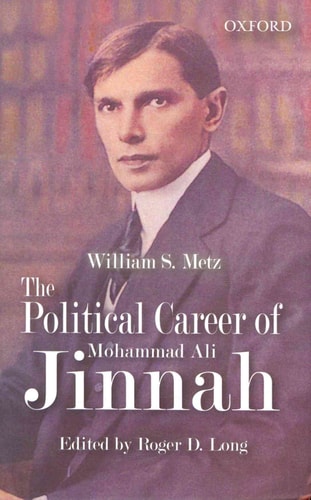
The Political Career of Mohammad Ali Jinnah
0
0
As an Amazon Associate and affiliate partner, Menrva Books earns from qualifying purchases. Learn more
Author Description
Mohammad Ali Jinnah (1876-1948) is chiefly known as the founder of Pakistan, and as such is widely revered in Pakistan and reviled in India. This book aims to present an impartial account of his career.Through a wide range of sources the author demonstrates how Jinnah started out as a secular-minded nationalist, dedicated to bringing independence to India through constitutional means, and eager to work through both Congress and the Muslim League to achieve Hindu-Muslim unity in the struggle. The highpoint of this strategy was the Congress-League Pact of 1916, but this could not be maintained. The book charts the stages in Jinnah's disillusion and change of direction. British repression after the First World War led Gandhi and Congress into policies of which he disapproved, and Gandhi's leadership with its Hindu-dominated tone also wounded him both personally and politically. He retired from politics in 1920 and when he returned in 1924 he tried a different tack, seeking to unite the Muslim League as the political vehicle for achieving Hindu-Muslim agreement. But here too he failed; his attempts at agreement with Congress were rebuffed and this weakened him within the League. When the 1930 Round Table Conference failed to produce unity, Jinnah again retired from politics. British initiatives during the 1930s met with divided responses.Increasingly worried at the prospect of active Hindu domination in an independent India, and at Congress's refusal to guarantee safeguards, Jinnah again returned to the fray and, as leader of the Muslim League, adopted Partition as the political principle for the subcontinent's Muslims. By holding unswervingly to this through all the negotiations, against considerable odds he achieved Pakistan.
Menrva's Summary
THE THESIS
This work investigates the political evolution of Mohammad Ali Jinnah, examining the factors that transformed him from a secular nationalist into the primary architect of the state of Pakistan. The authors, Roger D. Long and William S. Metz, utilize an extensive array of primary and secondary sources to construct a chronological analysis of Jinnah's career. They argue that his shift in political strategy was not an abrupt change, but a calculated response to the failure of constitutional unity efforts and the shifting dynamics between the Indian National Congress and the Muslim League.
THE SCOPE MAP
What You Will Find
- A detailed examination of the Congress-League Pact of 1916 and its subsequent collapse.
- Analysis of the impact of British colonial policies and the Round Table Conferences on Indian political movements.
- A study of Jinnah's internal struggles within the Muslim League and his reactions to Gandhi's leadership style.
- Documentation of the transition from a unified India advocacy to the adoption of the Partition principle.
THE AUTHORITY PERSPECTIVE
Scholars and historians recognize this text as a balanced, objective examination of a polarizing historical figure. Readers frequently note the academic rigor and the depth of archival research presented by the authors.
Page Count:
168
Publication Date:
2010-02-28
Publisher:
Oxford University Press
ISBN-10:
0195476735
ISBN-13:
9780195476736
Biography
History
Pakistan
International relations
Statesmen biography
Community Tags
Similar Books