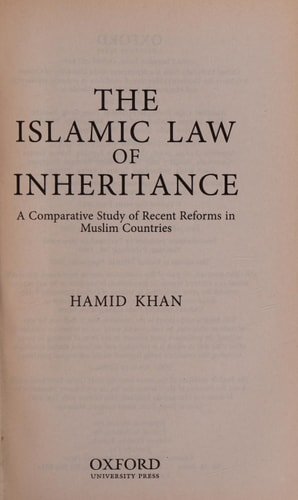
Islamic Law of Inheritance: A Comparative Study of Recent Reforms in Muslim Countries
0
0
As an Amazon Associate and affiliate partner, Menrva Books earns from qualifying purchases. Learn more
Author Description
Based on original sources, this book includes the historical and theological bases of the Islamic law of succession developed by the Muslim schools of jurisprudence. The author makes a comparative study between the Sunni and Shia laws of inheritance and focuses on problems being faced by Muslims due to the strict application of traditional Islamic law in their contemporary situations. This book is an essential component of the course on 'Muslim Personal Law' for LLB students and the course on 'Islamic Law' for LLM students.
Menrva's Summary
THE THESIS
This book investigates the historical, theological, and practical challenges inherent in the application of traditional Islamic inheritance laws within contemporary Muslim-majority nations. Hamid Khan, a legal scholar, utilizes primary sources and jurisprudential texts to examine the evolution of succession laws across different schools of thought. By contrasting Sunni and Shia legal frameworks, the author identifies the friction points between classical doctrine and modern societal needs. The text serves as a structured analysis of how various countries have implemented legislative reforms to address these discrepancies.
THE SCOPE MAP
What You Will Find
- Historical and theological foundations of Islamic succession law.
- Comparative analysis of Sunni and Shia inheritance jurisprudence.
- Examination of legislative reforms enacted in various Muslim countries.
- Discussion of practical difficulties arising from the application of traditional law in modern contexts.
THE AUTHORITY PERSPECTIVE
Legal scholars and educators frequently identify this work as a foundational text for students of Muslim Personal Law. Experts note that the book provides a clear, academic synthesis of complex jurisprudential debates, making it a standard resource for understanding the intersection of religious tradition and modern legal reform.
Page Count:
266
Publication Date:
2008-06-23
Publisher:
Oxford University Press
ISBN-10:
0195473361
ISBN-13:
9780195473360
History
Religion
Comparative Law
Islamic Law
Islamic Studies
Law
Inheritance And Succession
Community Tags
Similar Books