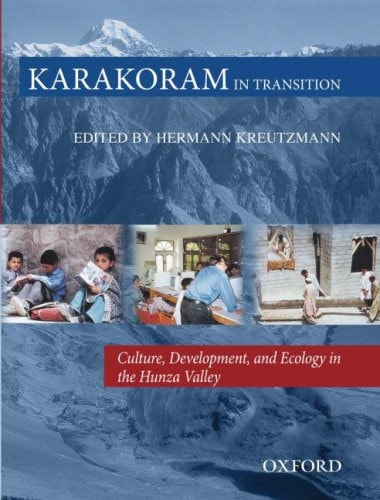
Karakoram in Transition: Culture, Development and Ecology in the Hunza Valley
0
0
As an Amazon Associate and affiliate partner, Menrva Books earns from qualifying purchases. Learn more
Author Description
In the age of globalization the interconnectedness of world regions is perceived to a much higher degree than ever before. The remoteness of mountain areas has been converted into a view of mountains as a resource centre from where life-spending water originates, as an abode of pristine cultures, herbs, and niches. Pakistan incorporates some of the highest mountain regions, and the Karakorams have been one of the least known for many centuries. Here we find some of the steepest slopes, mass mobilization, earthquakes and the water towers of humankind. At the same time these areas are of geopolitical interest in boundary making and control. Trade routes of the caravan age have been transformed into motorable roads such as the Karakoram Highway. The impact of these changes are addressed in this book in which for the first time eminent scholars from various disciplines cooperate in an international effort to combine state of the art research results about the Hunza Valley. The academic interest in different aspects from culture, ecology, economy and development has been the starting point for presenting the Hunza Valley as an example of high mountain research from which new insights into sustainable mountain development can be derived. Therefore the focus on a specific valley opens methodological and conceptual venues based on sound empirical data from fieldwork experiences. The Hunza Valley can be considered as an arena of research and development for half a century. With this book the most recent insights are presented in a holistic effort.
Menrva's Summary
THE THESIS
This book investigates how the Hunza Valley serves as a critical case study for understanding the intersection of globalization, ecological vulnerability, and sustainable development in high-mountain regions. Author Hermann Kreutzmann, a specialist in the geography of Central and South Asia, synthesizes decades of empirical fieldwork and multidisciplinary research to analyze the transformation of the Karakoram region. By examining the shift from traditional caravan trade to modern infrastructure like the Karakoram Highway, the text provides a framework for evaluating how remote mountain societies adapt to geopolitical and environmental pressures.
THE SCOPE MAP
What You Will Find
- Longitudinal analysis of the Hunza Valley spanning fifty years of research.
- Examination of the transition from traditional caravan trade routes to the modern Karakoram Highway.
- Multidisciplinary perspectives covering cultural, ecological, economic, and developmental dimensions.
- Empirical data regarding mass mobilization, seismic activity, and water resource management in high-altitude environments.
THE AUTHORITY PERSPECTIVE
Experts recognize this volume as a comprehensive, foundational text for scholars interested in high-mountain development and the socio-economic geography of Pakistan. Readers frequently note the academic density of the prose and the rigorous, evidence-based approach to complex regional issues.
Page Count:
419
Publication Date:
2006-01-01
Publisher:
Oxford University Press
ISBN-10:
0195472101
ISBN-13:
9780195472103
Social Life
Anthropology
Pakistan
Geography
Ecology
Community Tags
Similar Books