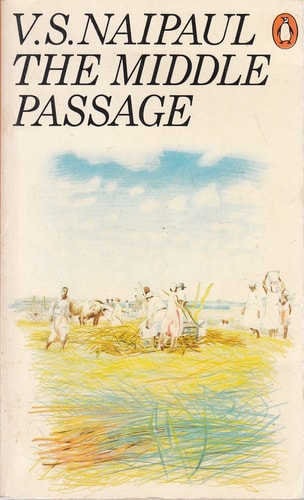
The Middle Passage: Impressions of Five Societies -- British, French and Dutch -- in the West Indies
0
0
As an Amazon Associate and affiliate partner, Menrva Books earns from qualifying purchases. Learn more
Author Description
In 1960 the government of Trinidad invited V. S. Naipaul to revisit his native country and record his impressions. In this classic of modern travel writing he has created a deft and remarkably prescient portrait of Trinidad and four adjacent Caribbean societies–countries haunted by the legacies of slavery and colonialism and so thoroughly defined by the norms of Empire that they can scarcely believe that the Empire is ending.In The Middle Passage, Naipaul watches a Trinidadian movie audience greeting Humphrey Bogart’s appearance with cries of “That is man!” He ventures into a Trinidad slum so insalubrious that the locals call it the Gaza Strip. He follows a racially charged election campaign in British Guiana (now Guyana) and marvels at the Gallic pretension of Martinique society, which maintains the fiction that its roads are extensions of France’s routes nationales. And throughout he relates the ghastly episodes of the region’s colonial past and shows how they continue to inform its language, politics, and values. The result is a work of novelistic vividness and dazzling perspicacity that displays Naipaul at the peak of his powers.
Menrva's Summary
THE THESIS
How do the lingering structures of colonial history and imperial identity shape the social and political realities of the West Indies in the mid-twentieth century? V. S. Naipaul, a Nobel laureate and native of Trinidad, utilizes his unique position as both an insider and a detached observer to document the cultural landscape of five Caribbean societies. Through a blend of reportage and personal reflection, he examines the psychological and structural remnants of British, French, and Dutch colonial rule, arguing that these nations remain tethered to the norms of their former masters even as the era of empire concludes.
THE SCOPE MAP
What You Will Find
- Observations on the social hierarchies and cultural pretenses in Trinidad, British Guiana, Martinique, and other Caribbean locales.
- Analysis of the impact of colonial history on contemporary language, politics, and local values.
- Detailed accounts of election cycles and daily life in post-colonial societies.
Scope Limits
- The text does not provide a comprehensive economic history of the region.
- It focuses primarily on the author's subjective impressions rather than exhaustive statistical data.
THE AUTHORITY PERSPECTIVE
Critics frequently cite this work as a foundational, if controversial, text in post-colonial travel literature due to its sharp, often uncompromising social critique. Scholars note that while the prose is highly accessible, the author's perspective remains deeply rooted in his specific intellectual background and the political climate of 1960.
Page Count:
256
Publication Date:
1993-09-01
Publisher:
Penguin Books
ISBN-10:
0140029206
ISBN-13:
9780140029208
Memoir
Travel
Literary
Caribbean History
Travel Writing
Sociology
Community Tags
Similar Books