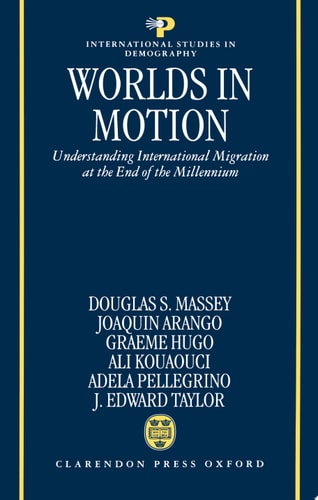
Worlds in Motion: Understanding International Migration at the End of the Millennium
0
0
As an Amazon Associate and affiliate partner, Menrva Books earns from qualifying purchases. Learn more
Author Description
Worlds in Motion seeks to create a comprehensive theory of international migration for the next century. After explicating the various propositions and hypotheses of current theories, and identifying areas of complementarity and conflict, the authors review empirical research emanating from each of the world's principal international migration systems: North America, Western Europe, the Gulf, Asia and the Pacific, and the Southern Cone of South America. Using data from the 1980s, levels and patterns of migration within each system are described to define their structure and organization. Specific studies are then comprehensively surveyed to evaluate the fundamental propositions of neoclassical economics, the new economics of labour migration, segmented labour market theory, world systems theory, social capital theory, and the theory of cumulative causation.
Menrva's Summary
THE THESIS
This work investigates the development of a comprehensive, unified theory of international migration capable of explaining global population movements at the turn of the millennium. The authors, a collaborative group of prominent demographers and sociologists, synthesize existing theoretical frameworks—including neoclassical economics and world systems theory—to evaluate their validity against empirical data. By contrasting these models, the text aims to reconcile conflicting hypotheses and establish a cohesive structure for understanding migration systems.
THE SCOPE MAP
What You Will Find
- Comparative analysis of migration systems in North America, Western Europe, the Gulf, Asia, the Pacific, and the Southern Cone of South America.
- Evaluation of neoclassical economics, new economics of labour migration, segmented labour market theory, world systems theory, social capital theory, and cumulative causation.
- Empirical data analysis derived from migration patterns observed during the 1980s.
Scope Limits
- The analysis is primarily constrained to data sets and migration structures prevalent during the 1980s and does not account for post-millennial geopolitical shifts.
THE AUTHORITY PERSPECTIVE
Experts recognize this text as a foundational comparative study that successfully bridges the gap between disparate economic and sociological theories of migration. Readers frequently note the academic density of the prose, which is intended for researchers and students of demography and international studies.
Page Count:
316
Publication Date:
1999-01-01
Publisher:
Clarendon Press
ISBN-10:
0191584088
ISBN-13:
9780191584084
Politics
Economics
Sociology
Categories
Custom Stores
Global Studies
Kindle Store
Self Service
Social Science
Demography
Kindle eBooks
Human Resources
International Migration