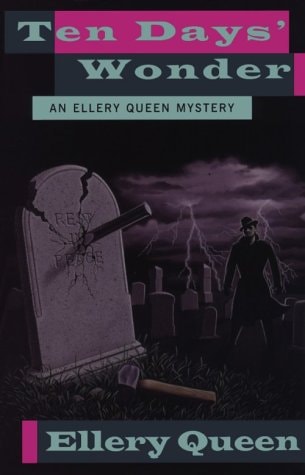
Ten Days' Wonder
0
0
As an Amazon Associate and affiliate partner, Menrva Books earns from qualifying purchases. Learn more
Author Description
Howard Van Horn, son of millionaire Diedrich Van Horn, comes to Ellery Queen with the request that Ellery investigate what Howard has been doing during a recent bout with amnesia. The trail leads to the small New England town of Wrightsville and what seems to be a love triangle with Howard's stepmother, the beautiful young Sally, from the "wrong side of the tracks" in class-conscious Wrightsville. A series of small and unusual crimes over the next nine days seem to be committed by Howard during amnesiac blackouts, and Ellery Queen suddenly realizes the bizarre pattern that underpins the series of crimes. But it is only after the murder of one Van Horn and the suicide of another that Ellery Queen can reveal the true pattern underlying events and bring a crime home to the criminal.
Menrva's Summary
THE PULSE
A young man suffering from recurring amnesia enlists a detective to uncover the truth behind his own potentially criminal actions. Howard Van Horn seeks out Ellery Queen to investigate a series of inexplicable events occurring during his blackouts, which draw the detective into the insular and class-conscious environment of Wrightsville. As the situation escalates from petty crimes to murder and suicide, Queen must navigate a complex web of familial secrets and psychological manipulation. The narrative follows a traditional investigative framework, focusing on the logical deconstruction of a bizarre pattern of behavior.
INSIDE THE PAGES
- Investigation of dissociative identity and amnesia-related crimes
- Setting centered on the small, class-stratified town of Wrightsville
- Exploration of a high-stakes love triangle involving a stepmother
- Systematic unraveling of a complex, multi-day criminal pattern
- Focus on the intellectual deduction methods of Ellery Queen
- Examination of family dynamics within a wealthy, influential household
- Pacing structured around a ten-day timeline of escalating events
- Climax involving a revelation of hidden motives and true culpability
THE COLLECTIVE ECHO
Readers frequently highlight this work as one of the more psychologically intense entries in the Ellery Queen canon. Discussion often centers on the darker, more somber tone compared to earlier, more puzzle-oriented mysteries in the series. Critics often point to the intricate plotting and the effective use of the Wrightsville setting to heighten the sense of social pressure on the characters. Many readers appreciate the shift toward character-driven motivations, though some note that the psychological elements add a layer of complexity that distinguishes it from standard whodunits. The resolution is widely regarded as a significant display of the protagonist's analytical capabilities.
Page Count:
272
Publication Date:
1966-09-01
Publisher:
Penguin
ISBN-10:
0140024972
ISBN-13:
9780140024975
Fiction
Mystery
Classic Crime
Westerns
Detective
Mystery Thriller & Suspense
Genre Fiction