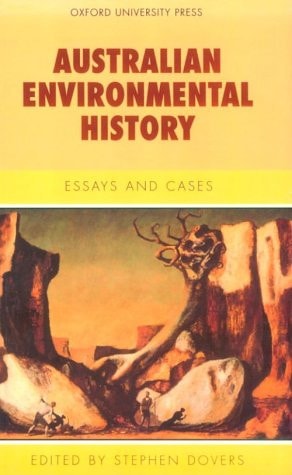
Australian Environmental History: Essays & Cases
0
0
As an Amazon Associate and affiliate partner, Menrva Books earns from qualifying purchases. Learn more
Author Description
This book explores past interactions between humans and the Australian environment - 'more a new planet than a new continent', as Eric Rolls says in his contribution - and offers insights into current environmental debates. Environmental history asks two simple questions: how did our present landscapes become what they are today, and what can we learn from this history? It draws on many disciplines and ways of investigating the world: ecology, history, geography, political science, philosophy, and others. Three overview essays explore the nature of Australian landscapes, the ways in which we have used and abused them, and our attitudes and perceptions about them. Seven case studies then explore, in further detail, human-environment interaction across a variety of scales of time (decades, centuries, millennia) and space. Included are analyses of small districts, large regions, and national resource centers, from the Reef and the Brigalow domain, through the high country and the arid center. The conclusion argues that the critical question facing us does not concern sustainable development, but rather how much damage the environment can sustain and still survive.
Menrva's Summary
THE THESIS
This book investigates how historical human interactions with the Australian landscape have shaped its current state and what lessons these patterns offer for future environmental management. Stephen Dovers, an expert in environmental policy and history, synthesizes contributions from various disciplines including ecology, geography, and political science to provide a comprehensive framework for understanding the continent's ecological evolution. The text argues that the central challenge for society is not merely sustainable development, but determining the threshold of environmental damage that ecosystems can withstand before collapse.
THE SCOPE MAP
What You Will Find
- Overview essays examining the nature of Australian landscapes and shifting human perceptions of the environment.
- Seven detailed case studies covering diverse geographical areas including the Great Barrier Reef and the arid center.
- Multi-scalar analysis of human-environment interactions spanning decades, centuries, and millennia.
- A multidisciplinary methodology integrating history, political science, and ecology to analyze resource management.
THE AUTHORITY PERSPECTIVE
Experts recognize this work as a foundational text for understanding the intersection of human activity and Australian ecological history. Readers frequently note the academic rigor of the case studies and the clarity with which the author connects historical data to contemporary environmental policy debates.
Page Count:
288
Publication Date:
1995-02-09
Publisher:
Oxford University Press
ISBN-10:
0195534824
ISBN-13:
9780195534825
History
Human ecology
Ecology
Geography
Nature
Australia
Community Tags
Similar Books