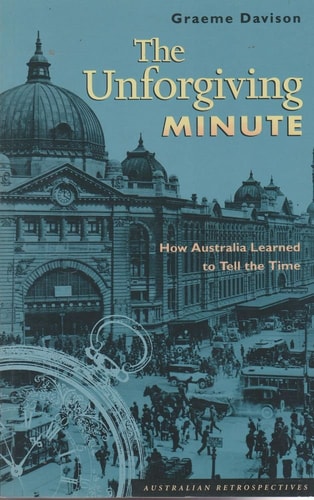
The Unforgiving Minute: How Australia Learned to Tell the Time
0
0
As an Amazon Associate and affiliate partner, Menrva Books earns from qualifying purchases. Learn more
Author Description
In asking how Australia learned to tell the time, Graeme Davison uncovers a surprising story. From ship's chronometers to digital clocks, from time-balls to time pips, from dreamtime to flexitime, clocks and time-keeping have been the quiet revolutionaries of Australian history. As the convict era drew to an end, the colonial governors looked to clocks as the mechanical policemen of an emerging free society. Fifty years later, as railways and telegraphs began to spread across the land, and pocket watches appeared on the waistcoats of working men, colonial society began to keep stricter hours of work and play, and to teach its children the virtue of punctuality. In the early 20th century, punch clocks and time-switches laid the basis for new patterns of work in the factory and the home. Now, in the 1990s, the "faceless clocks" in computers and automated control systems have created a "postmodern" time regime that is both more flexible, and more demanding, than its predecessors. Drawing on a wide range of theoretical insights and primary sources, "The Unforgiving Minute" offers an original interpretation of Australian history.
Menrva's Summary
THE THESIS
This book investigates how the evolution of time-keeping technology and the cultural adoption of punctuality functioned as a mechanism for social control and modernization in Australian history. Graeme Davison, a prominent historian, utilizes a wide array of primary sources and theoretical frameworks to trace the transition from colonial, pre-industrial time to the contemporary digital regime. He argues that the clock served as a 'mechanical policeman' during the convict era and later became an essential tool for structuring labor, education, and social life across the continent.
THE SCOPE MAP
What You Will Find
- Historical analysis of time-keeping devices from ship chronometers to digital computer clocks.
- Examination of the transition from colonial convict society to an industrialized, punctuality-focused nation.
- Integration of social history and technological development to explain shifts in work and leisure patterns.
- Theoretical exploration of how 'postmodern' time regimes impact modern life and automated control systems.
THE AUTHORITY PERSPECTIVE
Historians and social scientists frequently cite this work for its original synthesis of material culture and national history. Experts highlight the text as a foundational study on how mundane technologies shape the social fabric of a developing society.
Page Count:
160
Publication Date:
1993-01-01
Publisher:
Oxford University Press
ISBN-10:
0195534964
ISBN-13:
9780195534962
History
Technology
Social History
Sociology
Australia
Australian History
Time
Community Tags
Similar Books