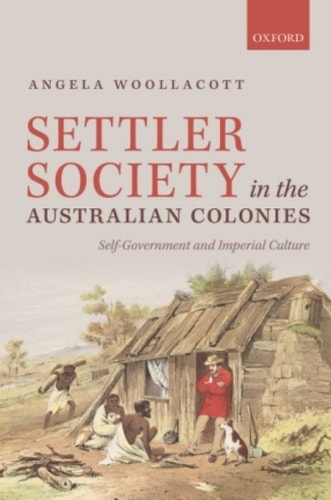
Settler Society in the Australian Colonies: Self-Government and Imperial Culture
0
0
As an Amazon Associate and affiliate partner, Menrva Books earns from qualifying purchases. Learn more
Author Description
The 1820s to the 1860s were a foundational period in Australian history, arguably at least as important as Federation. Industrialization was transforming Britain, but the southern colonies were pre-industrial, with economies driven by pastoralism, agriculture, mining, whaling and sealing, commerce, and the construction trades. Convict transportation provided the labour on which the first settlements depended before it was brought to a staggered end, first in New South Wales in 1840 and last in Western Australia in 1868. The numbers of free settlers rose dramatically, surging from the 1820s and again during the 1850s gold rushes. The convict system increasingly included assignment to private masters and mistresses, thus offering settlers the inducement of unpaid labourers as well as the availability of land on a scale that both defied and excited the British imagination. By the 1830s schemes for new kinds of colonies, based on Edward Gibbon Wakefield's systematic colonization, gained attention and support. The pivotal development of the 1840s-1850s, and the political events which form the backbone of this story were the Australian colonies' gradual attainment of representative and then responsible government. Through political struggle and negotiation, in which Australians looked to Canada for their model of political progress, settlers slowly became self-governing. But these political developments were linked to the frontier violence that shaped settlers' lives and became accepted as part of respectable manhood. With narratives of individual lives, Settler Society shows that women's exclusion from political citizenship was vigorously debated, and that settlers were well aware of their place in an empire based on racial hierarchies and threatened by revolts. Angela Woollacott particularly focuses on settlers' dependence in these decades on intertwined categories of unfree labour, including poorly-compensated Aborigines and indentured Indian and Chinese labourers, alo
Menrva's Summary
THE THESIS
This work investigates how the Australian colonies transitioned from convict-based settlements to self-governing entities while navigating the complexities of imperial culture and racial hierarchies. Angela Woollacott, a prominent historian of Australian and imperial history, utilizes archival records and biographical narratives to examine the socio-political evolution of the mid-19th century. She argues that the development of responsible government was inextricably linked to frontier violence, labor exploitation, and the rigid social structures of the British Empire.
THE SCOPE MAP
What You Will Find
- Analysis of the transition from convict transportation to free settler society between the 1820s and 1860s.
- Examination of Edward Gibbon Wakefield’s systematic colonization schemes.
- Discussion of the political influence of the Canadian model on Australian self-governance.
- Exploration of the intersection between political citizenship, gender exclusion, and racial hierarchies.
Scope Limits
- The text focuses primarily on the mid-19th century and does not provide an exhaustive history of the post-Federation era.
- The analysis is centered on the Australian colonies and does not offer a comprehensive comparative study of all British settler colonies.
THE AUTHORITY PERSPECTIVE
Historians and scholars of colonial studies frequently cite this work for its nuanced integration of political history with social and labor history. Experts highlight the text as a significant contribution to understanding how imperial power dynamics shaped the foundational structures of Australian society.
Page Count:
288
Publication Date:
2015-01-01
Publisher:
OUP Oxford
ISBN-10:
0191017736
ISBN-13:
9780191017735
History
Colonialism
Social History
Australian History
New Zealand
Political History
Imperialism
Australia
Community Tags
Other Editions(2)

Similar Books



Reader Comments
Share Your Thoughts
No comments yet. Be the first to share your thoughts!