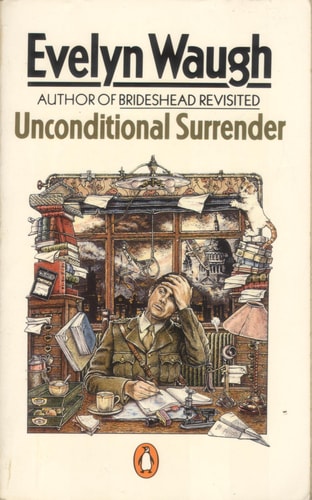
Unconditional Surrender
0
0
As an Amazon Associate and affiliate partner, Menrva Books earns from qualifying purchases. Learn more
Author Description
By 1941, after serving in North Africa and Crete, Guy Crouchback has lost his Halberdier idealism. A desk job in London gives him the chance of reconciliation with his former wife. Then, in Yugoslavia, as a liaison officer with the partisans, Crouch becomes finally and fully aware of the futility of a war he once saw in terms of honor. Unconditional Surrender is the third novel in Waugh's brilliant Sword of Honor trilogy recording the tumultuous wartime adventures of Guy Crouchback ("the finest work of fiction in English to emerge from World War II" -Atlantic Monthly), which also comprises Men at Arms and Officers and Gentlemen.
Menrva's Summary
THE PULSE
Guy Crouchback faces the final collapse of his romanticized notions of military honor as he navigates the bureaucratic and political chaos of the Second World War. Crouchback, now disillusioned by his experiences in North Africa and Crete, attempts to find personal stability through a desk job in London and a potential reconciliation with his former wife. His assignment as a liaison officer in Yugoslavia forces him into direct contact with the shifting alliances and moral ambiguities of partisan warfare. The narrative employs a third-person perspective to observe the protagonist's gradual realization that the conflict lacks the chivalric structure he once envisioned. The world is defined by the rigid, often absurd hierarchies of the British military and the brutal, unpredictable reality of the Balkan front.
INSIDE THE PAGES
- Satirical depiction of military bureaucracy and incompetence
- Exploration of the decline of aristocratic values
- Examination of the moral ambiguity inherent in wartime alliances
- Use of dark humor to highlight the absurdity of conflict
- Focus on the psychological erosion of the protagonist
- Detailed portrayal of the Yugoslavian partisan landscape
- Critique of the shifting political landscape of the 1940s
- Integration of personal domestic struggles with global historical events
THE COLLECTIVE ECHO
Readers and critics frequently observe that this novel serves as a somber conclusion to the trilogy, shifting from the earlier comedic tone toward a more cynical assessment of the war. Discussion often centers on the protagonist's internal transformation and his eventual acceptance of the futility surrounding his service. Many highlight the author's precise prose and his ability to balance sharp social commentary with the grim realities of the battlefield. The work is often evaluated for its portrayal of the betrayal of traditional values in the face of modern political necessity. Readers appreciate the consistency of the character development across the three volumes, noting that the final installment provides a definitive, if bleak, resolution to the narrative arc.
Page Count:
240
Publication Date:
1964-01-07
Publisher:
Penguin UK
ISBN-10:
0140021221
ISBN-13:
9780140021226
Historical Fiction
Satire
Military
Contemporary
British literature
War
Community Tags
Similar Books