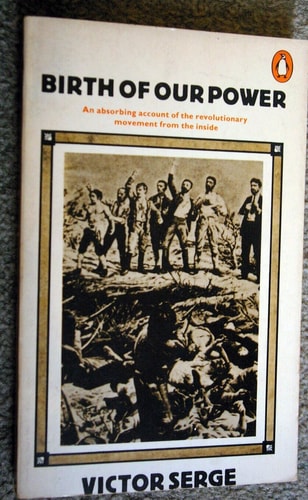
Birth of Our Power
0
0
As an Amazon Associate and affiliate partner, Menrva Books earns from qualifying purchases. Learn more
Author Description
Birth of Our Power is an epic novel set in Spain, France, and Russia during the heady revolutionary years 1917–1919. Serge’s tale begins in the spring of 1917, the third year of mass slaughter in the blood-and-rain-soaked trenches of World War I, when the flames of revolution suddenly erupt in Russia and Spain. Although the Spanish uprising eventually fizzles, in Russia the workers, peasants, and common soldiers are able to take power and hold it. Serge’s “tale of two cities” is constructed from the opposition between Barcelona, the city “we” could not take, and Petrograd, the starving, beleaguered capital of the Russian Revolution besieged by counter-revolutionary Whites. Between the romanticism of radicalized workers awakening to their own power in a sun-drenched Spanish metropolis to the grim reality of workers clinging to power in Russia’s dark, frozen revolutionary outpost. The novel was composed a decade after the revolution in Leningrad, where Serge was living in semicaptivity because of his declared opposition to Stalin’s dictatorship over the revolution.
Menrva's Summary
THE PULSE
The narrative captures the volatile intersection of personal conviction and global upheaval as revolutionary fervor ignites across Europe between 1917 and 1919. The protagonist navigates the stark contrast between the failed uprising in Barcelona and the precarious victory of the Bolsheviks in Petrograd. Faced with the physical brutality of World War I trenches and the logical constraints of ideological warfare, the narrator struggles to reconcile the promise of collective liberation with the encroaching reality of state authoritarianism. The narrative framework utilizes a reflective, semi-autobiographical perspective to examine the psychological toll of political commitment during a period of extreme social instability.
INSIDE THE PAGES
- Dual-setting structure contrasting Barcelona and Petrograd
- First-person reflective narrative voice
- Historical documentation of the 1917–1919 revolutionary period
- Exploration of the transition from idealism to bureaucratic control
- Sensory descriptions of trench warfare and urban insurrection
- Analysis of the psychological impact of political imprisonment
- Examination of the tension between individual agency and mass movements
- Stylistic focus on the grim realities of revolutionary survival
THE COLLECTIVE ECHO
Readers and critics frequently describe this work as a vital document of the early twentieth-century revolutionary experience. Discussion often centers on the author's ability to balance intense political theory with the visceral, often bleak, atmosphere of a world in transition. Many highlight the effectiveness of the dual-city structure in illustrating the fragility of radical movements when faced with entrenched power. Critics often note that the prose maintains a high level of intellectual rigor while remaining grounded in the physical suffering of the participants. The text is widely regarded as a significant contribution to the literature of political dissent, offering a perspective that is both deeply personal and historically expansive.
Page Count:
262
Publication Date:
1970-07-30
Publisher:
Penguin
ISBN-10:
0140031405
ISBN-13:
9780140031409
History
Historical Fiction
Biography
Fiction
Political fiction
War
Revolutionary History
European
Community Tags
Similar Books