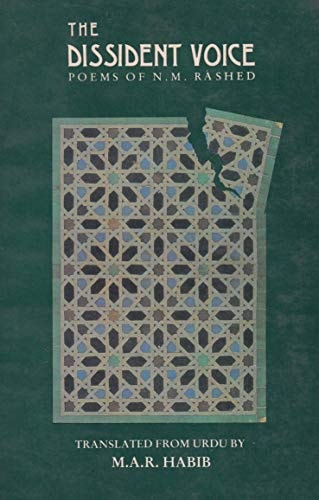
The Dissident Voice: Poems of N.M. Ráshed
0
0
As an Amazon Associate and affiliate partner, Menrva Books earns from qualifying purchases. Learn more
Author Description
One of the major modern poets of the Urdu language in the twentieth century, N.M. Ráshed lived and wrote at a time of tremendous upheaval both within and outside the Islamic world--the period between the two World Wars. Viewed as anarchic for his passionate defense of democracy and individualism, Ráshed was responsible for spearheading a modernist movement in Urdu literature. His many critics failed to see that his apparent religious heterodoxy was itself a version of faith, often reflected in his verse as an intense, if tragic, spiritual struggle expressed in earthly terms. Attacking a tradition while remaining within it, Ráshed turned the ghazal, primarily a love lyric and itself a subversive verse form, into a powerful weapon of protest. A composite picture of the world and works of Ráshed is presented here for the first time in English translation with poems drawn from various collections of his verse.
Menrva's Summary
THE PULSE
N.M. Ráshed navigates the volatile intersection of personal faith and political upheaval through the subversive medium of modern Urdu poetry. Ráshed positions himself as a voice of dissent, challenging the rigid structures of his cultural and religious environment while simultaneously operating within them. His objective is to articulate the tension between individual autonomy and the collective pressures of a world defined by the instability of the interwar period. The narrative framework of this collection is presented through English translations that capture the intellectual and spiritual struggle of a poet who utilized the ghazal as a vehicle for protest and democratic advocacy.
INSIDE THE PAGES
- Exploration of modernist themes within the traditional Urdu ghazal structure
- Analysis of the poet's role as a social and political dissident
- Examination of the tension between religious heterodoxy and personal faith
- Translation of verse reflecting the geopolitical instability of the twentieth century
- Critique of traditional literary forms as tools for individual expression
- Focus on the intersection of democracy and individual identity
- Contextualization of Ráshed's work within the broader Islamic world
- Synthesis of biographical detail and poetic output
THE COLLECTIVE ECHO
Readers and critics frequently highlight the significance of this collection in introducing Ráshed's complex modernist vision to an English-speaking audience. Discussion often centers on the poet's ability to transform the traditional love lyric into a sharp instrument of political and social critique. Observers note that the balance between the translated verse and the provided biographical context allows for a deeper understanding of Ráshed's internal spiritual conflicts. The work is widely regarded as a vital resource for those interested in the evolution of twentieth-century Urdu literature and the role of the poet as a public intellectual.
Page Count:
138
Publication Date:
1993-03-25
Publisher:
Oxford University Press
ISBN-10:
0195627415
ISBN-13:
9780195627411
Biography
Poetry
Urdu
Literary Criticism
Criticism history
Modernism
Community Tags
Similar Books