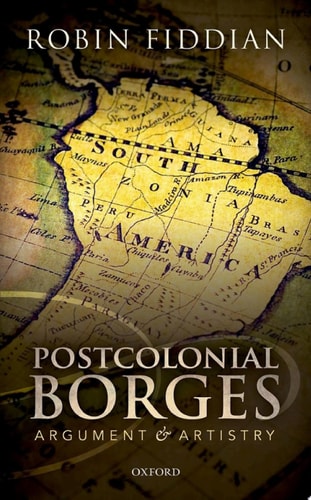
Postcolonial Borges: Argument and Artistry
0
0
As an Amazon Associate and affiliate partner, Menrva Books earns from qualifying purchases. Learn more
Author Description
Postcolonial Borges is the first systematic account of geo-political and postcolonial themes in a range of writings by Borges, from the poetry and essays of the 1920s, through the prose and poetry of the middle years (the 40s, 50s, and 60s), to the stories of El informe de Brodie and the poems of La cifra and other later collections. Robin Fiddian analyses the development of a postcolonial sensibility in works such as 'Mythical Founding of Buenos Aires', 'Tlön, Uqbar, Orbis Tertius', 'Theme of the Traitor and the Hero', and 'Brodie's Report'. He examines Borges's treatment of national and regional identity, and of East-West relations, in several essays and poems, contained, for example, in Other Inquisitions and Seven Nights. The theoretical concepts of 'coloniality' and 'Occidentalism' shed new light on several works by Borges, who acquires a sharper political profile than previously acknowledged. Fiddian pays special attention to Oriental subjects in Borges's works of the 70s and 80s, where their treatment is bound up with a critique of Occidental values and assumptions. Classified by some commentators over the years as a precursor of post-colonialism, Borges in fact emerges as a prototype of the postcolonial intellectual exemplified by James Joyce, Aimé Césaire (for example), and Edward Said. From a regional perspective, his repertoire of geopolitical and historical concerns resonates with those of Leopoldo Zea, Enrique Dussel, Eduardo Galeano, and Joaquín Torres García, who illustrate different strands and kinds of Latin American post-colonialism(s) of the twentieth century. At the same time, manifest differences in respect of political and artistic temperament mark Borges out as a postcolonial intellectual and creative writer who is sui generis.
Menrva's Summary
THE THESIS
This book investigates the extent to which Jorge Luis Borges functions as a postcolonial intellectual through an analysis of his geopolitical and cultural themes. Robin Fiddian, an expert in Latin American literature, utilizes a framework of 'coloniality' and 'Occidentalism' to re-evaluate Borges's body of work. By tracing his development from the 1920s through the 1980s, the author argues that Borges possesses a sharper political profile than traditional scholarship has previously recognized.
THE SCOPE MAP
What You Will Find
- A chronological analysis of Borges's poetry, essays, and short stories.
- Application of postcolonial theoretical concepts to specific texts like 'Tlön, Uqbar, Orbis Tertius' and 'Brodie's Report'.
- Comparative studies linking Borges to figures such as James Joyce, Aimé Césaire, and Edward Said.
Scope Limits
- The text focuses primarily on political and postcolonial dimensions, rather than providing a comprehensive biographical account of Borges's life.
- It does not attempt to cover every minor work, focusing instead on key texts that illustrate the author's evolving postcolonial sensibility.
THE AUTHORITY PERSPECTIVE
Scholars recognize this work as a significant contribution to Borges studies for its systematic application of postcolonial theory to a writer often viewed as apolitical. Readers frequently note the academic density of the prose, which serves as a rigorous resource for those interested in the intersection of Latin American literature and political theory.
Page Count:
238
Publication Date:
2017-01-01
Publisher:
OUP Oxford
ISBN-10:
0192513672
ISBN-13:
9780192513670
Biography
English
Latin American
Political Theory
Literary Criticism
Criticism history
English & College Success
Community Tags
Similar Books