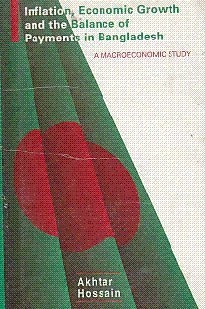
Inflation, Economic Growth and the Balance of Payments in Bangladesh: A Macroeconomic Study
0
0
As an Amazon Associate and affiliate partner, Menrva Books earns from qualifying purchases. Learn more
Author Description
M.A. Hossain takes a closer, critical look at Bangladesh's inflation and balance of payments. Using a combination of structural and monetary theories he develops an integrated, quarterly, macroeconomic model of inflation, economic growth and balance of payments for the period 1974 to 1985. The model used is based on two hypotheses: that inflation in Bangladesh is a monetary phenomenon, and that persistent trade deficits are inherent in its foreign-aid-based development strategy and its overvalued exchange rate policy.
Menrva's Summary
THE THESIS
This study investigates the complex interplay between inflation, economic growth, and the balance of payments within the specific context of Bangladesh's developing economy. Akhtar Hossain, an economist specializing in South Asian macroeconomic policy, utilizes a rigorous quantitative framework to analyze the period between 1974 and 1985. By synthesizing structural and monetary theories, the author constructs an integrated quarterly model to evaluate how monetary policy and foreign-aid-dependent strategies influence national economic stability. The work argues that inflation is primarily a monetary phenomenon, while trade deficits are structural consequences of specific exchange rate policies.
THE SCOPE MAP
What You Will Find
- A comprehensive quarterly macroeconomic model covering the years 1974 to 1985.
- An analysis of the relationship between foreign-aid-based development strategies and persistent trade deficits.
- A critical evaluation of the impact of overvalued exchange rate policies on national economic growth.
- A comparative application of structural and monetary economic theories to a developing nation's data.
THE AUTHORITY PERSPECTIVE
Economists and researchers in the field of development studies frequently cite this work as a foundational quantitative analysis of the Bangladeshi economy during its post-independence formative years. Readers often note the technical density of the prose, which assumes a solid background in econometrics and macroeconomic theory.
Page Count:
408
Publication Date:
1995-10-26
Publisher:
Oxford University Press
ISBN-10:
0195631080
ISBN-13:
9780195631081
Economics
Bangladesh
Finance
Macroeconomics
Community Tags
Similar Books