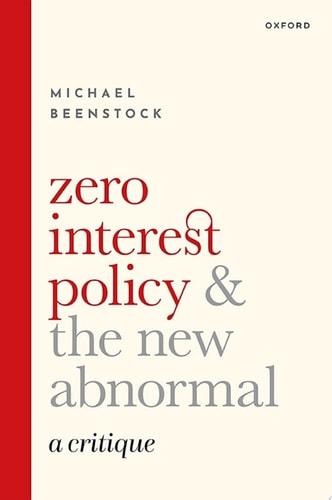
Zero Interest Policy and the New Abnormal: A Critique
0
0
As an Amazon Associate and affiliate partner, Menrva Books earns from qualifying purchases. Learn more
Author Description
In the 'New Normal' central banks set their interest rate to zero and print money through massive quantitative easing, while finance ministries run huge fiscal deficits. Yet inflation remains minimal. Zero Interest Policy and the New Abnormal explains why. It also explains why the New Normal is really the New Abnormal, and why it can't last. This study traces the academic roots of the New Abnormal to a conceptual confusion about the 'natural rates of interest', and postmodernism in macroeconomics, exemplified by the DSGE (dynamic stochastic general equilibrium) movement. It develops a theory of 'existential risk' which is concerned with the collapse of political economies such the Bretton Woods system and the New Abnormal. The book demonstrates that existential risk expresses itself in the growing gap between the natural rate of interest, measured by the rate of return on capital, and the real rate of interest, as well as in the development of cryptocurrencies. Beenstock develops a theory of 'kinetic inflation' based on Keynes' liquidity trap, which accounts for the absence of inflation in the New Abnormal, and predicts its outbreak when zero interest policy ends. He also explores the adverse social consequences of the New Abnormal for fertility, pensions, house prices, economic inequality, and intergenerational equity and establishes a causal link from the New Abnormal to Covid-19 mitigation policy, and from the latter to the intensification of the New Abnormal. Finally, it assesses the prospects for ending the New Abnormal, and an orderly return to the Old Normal. The alternative is to crash-out of the New Abnormal chaotically.
Menrva's Summary
THE THESIS
This book investigates the economic and social consequences of zero interest rate policies and quantitative easing, arguing that current central bank practices represent an unsustainable 'New Abnormal' rather than a stable economic paradigm. Michael Beenstock, a professor of economics, utilizes historical data and macroeconomic theory to challenge the prevailing DSGE models. He posits that the disconnect between the natural rate of interest and real interest rates creates existential risks for political economies, ultimately predicting inflationary outcomes when these policies are abandoned.
THE SCOPE MAP
What You Will Find
- Analysis of the 'liquidity trap' and the theory of 'kinetic inflation'.
- Examination of the impact of zero interest policies on pensions, housing markets, and fertility rates.
- Theoretical framework linking macroeconomic policy to the emergence of cryptocurrencies and political instability.
Scope Limits
- The text focuses primarily on Western-style central banking systems and may not address emerging market economies in equal depth.
- It does not provide a prescriptive investment manual for individual portfolios.
THE AUTHORITY PERSPECTIVE
Economists and financial analysts note that this text provides a rigorous, albeit critical, challenge to modern central banking orthodoxy. The prose is dense and requires a foundational understanding of macroeconomic theory to fully grasp the author's arguments regarding existential risk and interest rate dynamics.
Page Count:
640
Publication Date:
2022-01-01
Publisher:
OUP Oxford
ISBN-10:
0192666428
ISBN-13:
9780192666420
Economics
Finance
Principles of Macroeconomics
Macroeconomics
Community Tags
Similar Books