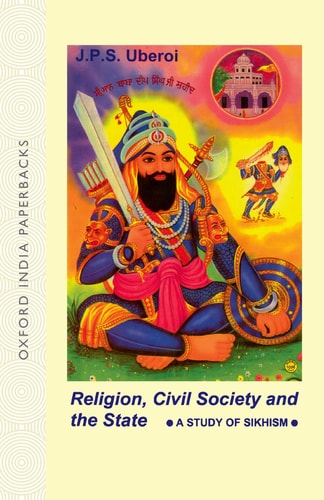
Religion, Civil Society and the State: A Study of Sikhism
0
0
As an Amazon Associate and affiliate partner, Menrva Books earns from qualifying purchases. Learn more
Author Description
Religion, civil society and the state form the three dimensions of this semiological study of sikhism. Uberoi first explains the underlying structure of medievalism in both Hindu and Muslim cultures, and goes on to undertake an examination of the period of collaboration between Sikhism and Gandhism after the revolution of Islam in Iran. The figure of the martyr is seen to be an integral part of Sikhism, Gandhism, and Shia Islam.
Menrva's Summary
THE THESIS
This study investigates the structural relationship between religion, civil society, and the state through the specific lens of Sikhism. J. P. S. Uberoi, a prominent sociologist, utilizes a semiological framework to analyze how these three dimensions interact within historical and cultural contexts. By comparing Sikhism with Hindu and Muslim traditions, the author argues that specific religious figures, particularly the martyr, serve as critical nodes for understanding political and social collaboration in the modern era.
THE SCOPE MAP
What You Will Find
- A semiological analysis of the structural dimensions of Sikhism.
- Comparative examination of medievalism in Hindu and Muslim cultural frameworks.
- An exploration of the collaborative period between Sikhism and Gandhism following the Iranian Revolution.
- A thematic study of the figure of the martyr across Sikh, Gandhian, and Shia Islamic traditions.
THE AUTHORITY PERSPECTIVE
Scholars of South Asian studies and sociology frequently cite this work for its rigorous theoretical approach to religious institutions and their political implications. Readers often note the academic density of the prose, which requires a foundational understanding of sociological theory to fully grasp the author's arguments.
Page Count:
190
Publication Date:
1999-04-29
Publisher:
Oxford University Press
ISBN-10:
0195648528
ISBN-13:
9780195648522
Philosophy
Religion
History
Sociology
Sikhism