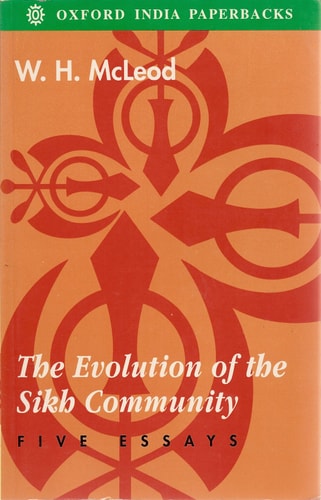
The Evolution of the Sikh Community: Five Essays
0
0
As an Amazon Associate and affiliate partner, Menrva Books earns from qualifying purchases. Learn more
Author Description
Sikh history has traditionally been regarded as a paradox. Beginning in the early sixteenth century as a system of internal devotion. Sikhism emerges into prominence during the eighteenth century as a clearly defined belief laying powerful stress upon external symbols. In a series of five essays this book examines Sikh history, scriptures, and society, seeking to show that the evolution of the community during the last 500 years has been a direct response to circumstances in the Punjab.
Menrva's Summary
THE THESIS
This collection of essays investigates the historical transformation of the Sikh community from a system of internal devotion into a distinct religious identity defined by external symbols. W. H. McLeod, a prominent scholar of Sikh studies, utilizes historical analysis and textual examination to argue that the evolution of Sikhism over the last five centuries is a direct, adaptive response to the socio-political circumstances within the Punjab region. The work provides a structured framework for understanding how religious doctrine and social practice shifted in tandem with regional pressures.
THE SCOPE MAP
What You Will Find
- Historical analysis of the Sikh community spanning the last 500 years
- Examination of the development of Sikh scriptures and their societal impact
- Investigation into the transition from internal devotion to externalized religious symbols
- Contextual study of the Punjab region as a driver for religious evolution
THE AUTHORITY PERSPECTIVE
Scholars and students of religious history frequently cite this work as a foundational text for understanding the complexities of Sikh identity formation. Readers often note the academic rigor and the clarity with which McLeod navigates the historical paradoxes of the tradition.
Page Count:
127
Publication Date:
1996-08-15
Publisher:
Oxford University Press
ISBN-10:
0195637372
ISBN-13:
9780195637373
History
Non-Fiction
Religion
Sikhs
Sociology
Sikhism
Community Tags
Similar Books