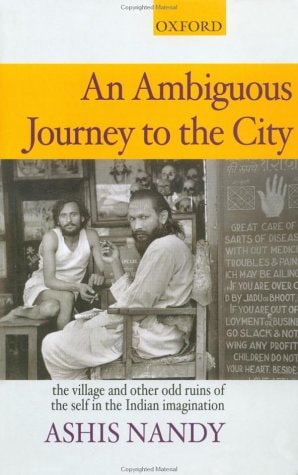
An Ambiguous Journey to the City: The Village and Other Odd Ruins of the Self in the Indian Imagination
0
0
As an Amazon Associate and affiliate partner, Menrva Books earns from qualifying purchases. Learn more
Author Description
This book examines the myth of the journey from the village to the city and shows how this myth and the changes it has undergone provide rich insight on India's ambivalent affair with the modern city. The first section looks at the vicissitudes of the metaphor of journey, especially the imagination of the hero as it intersects with the imagined city. The next two sections profile various heroes as they negotiate the transitions from the village to the city and back to the village. The final section focuses on the psychopathological journey from a poisoned village into a self-annihilating city, and the narrative draws parallels with the violence in 1946-8, the period which saw the birth of modern India and Pakistan.
Menrva's Summary
THE THESIS
This book investigates the cultural and psychological implications of the migration myth from the village to the city within the context of modern Indian identity. Ashis Nandy, a prominent political psychologist and social theorist, utilizes a multidisciplinary framework to analyze how the transition between rural and urban spaces shapes the Indian imagination. By examining literary figures, historical narratives, and social transitions, Nandy argues that the city-village dichotomy serves as a critical lens for understanding the anxieties and violence inherent in the formation of modern India and Pakistan.
THE SCOPE MAP
What You Will Find
- Analysis of the metaphorical journey from rural village life to the modern urban center.
- Profiles of various literary and historical heroes navigating the transition between village and city.
- Examination of the psychopathological dimensions of urban migration and self-annihilation.
- Historical parallels drawn between urban development and the communal violence of 1946-1948.
THE AUTHORITY PERSPECTIVE
Scholars and critics frequently cite this work as a foundational text for understanding the intersection of post-colonial psychology and urban sociology in South Asia. Readers often note the dense, theoretical nature of Nandy's prose, which requires a familiarity with Indian cultural history to fully grasp the nuances of his argument.
Page Count:
164
Publication Date:
2001-05-17
Publisher:
Oxford University Press
ISBN-10:
0195652428
ISBN-13:
9780195652420
Psychology
India
Urban Studies
Sociology
Indian History
Community Tags
Similar Books