Electrical Properties of Materials
0
0
As an Amazon Associate and affiliate partner, Menrva Books earns from qualifying purchases. Learn more
Author Description
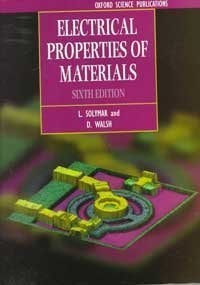
The seventh edition of this classic text illustrates the fundamentals of the electrical properties of materials in the context of contemporary engineering applications. Written in an informal, accessible style, it emphasizes the core ideas relevant to understanding the subject and deliberately keeps the mathematical treatment simple. The book presents the simplest model that can display the essential properties of a phenomenon and examines it, showing the difference between ideal and actual behavior. Topics are selected so that the operation of devices having applications (or possible future applications) in engineering can be explained. Problems and worked examples are included throughout.Features of the Seventh EditionBLPresents a comprehensive treatment of light emitting diodes, which are rapidly replacing classical lighting sourcesBLCovers new topics such as organic material (including various polymers) and artificial materials (including photonic gap materials and metamaterials)BLProvides insight into cutting-edge fields such as amorphous semiconductors and nanotechnologyBLDiscusses new devices including nanotube transistors, single electron transistors, magnetic tunnel junctions, quantum cascade lasers, and ferroelectric and superconducting memoriesBLA solutions manual and illustrations from the text are available for download at: http://www.oup.com/uk/booksites/content/0199267936/
Menrva's Summary
THE THESIS
This text investigates the fundamental electrical properties of materials by bridging theoretical physics with contemporary engineering applications. Authors D. Walsh and L. Solymar utilize a pedagogical approach that prioritizes conceptual clarity over complex mathematical derivations. By focusing on simplified models that reveal essential physical behaviors, the authors provide a framework for understanding both ideal material properties and their practical deviations in real-world devices.
THE SCOPE MAP
What You Will Find
- Comprehensive analysis of semiconductor physics and light-emitting diodes.
- Coverage of advanced materials including polymers, photonic gap materials, and metamaterials.
- Examination of modern electronic devices such as nanotube transistors, single electron transistors, and magnetic tunnel junctions.
- Practical pedagogical tools including worked examples and end-of-chapter problems.
THE AUTHORITY PERSPECTIVE
Experts and educators frequently cite this work as a foundational text for undergraduate engineering students due to its accessible prose and focus on physical intuition. Readers often note that the text successfully balances theoretical depth with the practical requirements of modern device engineering.
Page Count:
416
Publication Date:
2004-01-22
Publisher:
Oxford University Press
ISBN-10:
0195672259
ISBN-13:
9780195672251
Engineering
New Used & Rental Textbooks
Categories
Nuclear Chemistry
Mechanical
textbook
Nanostructures
Kindle eBooks
Kindle Store
Physics
Electronics