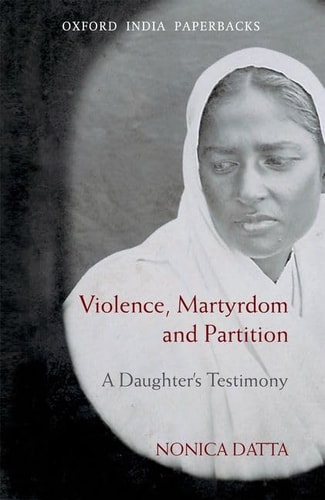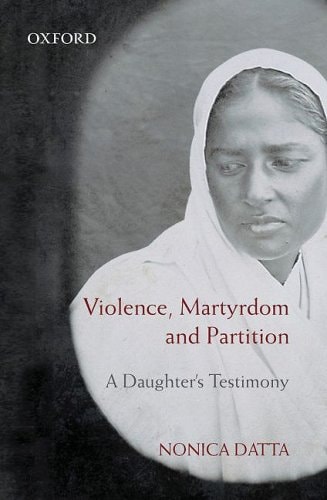
Violence, Martyrdom, and Partition: A Daughter's Testimony
0
0
As an Amazon Associate and affiliate partner, Menrva Books earns from qualifying purchases. Learn more
Author Description
This book presents the oral testimony of Subhashini (1914-2003), the woman head of a well-known Arya Samaj institution devoted to women's education in rural north India. Subhashini's narrative unfolds a story, within a sea of stories, which has remained silent in the dominant historical discourse. Her memory evokes contrasting images of violence, martyrdom and Partition. Not 1947 but 1942--the year of her father's 'martyrdom'--is recalled as a violent rupture in her memory. Partition is a moment of celebration, revenge, divine retribution, empathy, remorse, tragedy and fear.Translating Subhashini's oral testimony, Nonica Datta recreates the memory of a colonial subject, living in postcolonial times, as a historical narrative. Moving beyond a historical event and well-established historical facts, Violence, Martyrdom and Partition is a parallel history of events and non-events, memory and history, testimony and experience. Breaking the silence of an oral testimony and presenting memory as history, this work opens up the historians' territory.This testimony defies the opposition between subject and agent, victim and victimizer, witness and survivor, aggressor and spectator, perpetrator and bystander. Subhashini's candid, repetitive narrative suggests a remarkable interplay of individual and collective remembrance, and reveals the shifts, ambiguities, silences and contradictions in an individual memory.
Menrva's Summary
THE THESIS
This work investigates how individual oral testimony can challenge and expand the boundaries of dominant historical discourse regarding the Partition of India. Author Nonica Datta, a historian, utilizes the personal narrative of Subhashini, a rural educator, to examine the intersection of memory, violence, and identity. By framing the 1942 death of Subhashini's father as a primary rupture, the book argues that personal experience often diverges from the conventional chronological focus on 1947, providing a more nuanced understanding of the era's trauma and social shifts.
THE SCOPE MAP
What You Will Find
- A detailed oral history of Subhashini (1914-2003) regarding her life in rural north India.
- An analysis of the 1942 period as a significant historical rupture distinct from the 1947 Partition.
- A methodological framework for translating oral testimony into a formal historical narrative.
- Exploration of the complex roles of victim, witness, and survivor within the context of communal violence.
THE AUTHORITY PERSPECTIVE
Scholars and historians recognize this work as a significant contribution to the field of subaltern studies and oral history. Readers frequently note the academic density of the prose and the author's success in balancing personal memory with broader historical analysis.
Page Count:
235
Publication Date:
2009-04-30
Publisher:
Oxford University Press
ISBN-10:
0195699343
ISBN-13:
9780195699340
History
Biography
India
Oral History
Ethnic relations
Partition
Community Tags
Similar Books