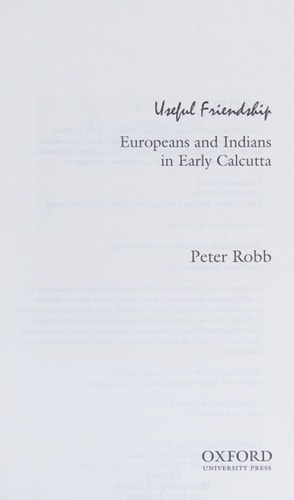
Useful Friendship: Europeans and Indians in Early Calcutta
0
0
As an Amazon Associate and affiliate partner, Menrva Books earns from qualifying purchases. Learn more
Author Description
This book describes how friendship or quasi-friendly behaviour underwrote British life and work in Calcutta before and after 1800, even between patrons and clients, and when personal relations were not amicable. Amid the uncertainties as a new town was created, the parameters of proper behaviour were defined by sociability, trust, and reputation. The book explains friendship's role in credit and debt; in town-development, securing contracts, and managing work; and in early colonial law and administration. It suggests that personal experiences and mores aided the acceptance of formal regulation, and the convenient invention of a 'virtuous' public identity for the imperial British.The book seeks to explain, secondly, why Indians were not fully integrated into the Europeans' notions and rituals of friendship, though many Europeans and Indians lived and worked very closely together. Without backing easy notions about racism or power, it illustrates mutual failures of inclusion and understanding in European-Indian relations.The book is the last of three studies based on the huge diary of Richard Blechynden, architect and surveyor. Though somewhat more broadly based than its predecessors, it still analyses rich evidence from the diary, showing how it adds to our understanding of intellectual, social, and political trends. The detailed stories provide an important pre-history of imperial rule and its justifications, and of racial distinctions and division.
Menrva's Summary
THE THESIS
This book investigates how social networks, specifically the concept of friendship, functioned as a foundational mechanism for British colonial administration and daily life in early Calcutta. Peter Robb, a distinguished historian of South Asia, utilizes the extensive personal diaries of architect and surveyor Richard Blechynden to reconstruct the social fabric of the late 18th and early 19th centuries. By analyzing the intersection of personal reputation, credit systems, and colonial governance, the author argues that sociability served as a pragmatic tool for managing the uncertainties of imperial expansion. The work examines the paradox of close working relationships between Europeans and Indians that nonetheless failed to bridge deep-seated cultural and structural divides.
THE SCOPE MAP
What You Will Find
- Analysis of the role of social trust in colonial credit, debt, and contract management.
- Examination of the limitations of cross-cultural integration between Europeans and Indians in colonial settings.
- Utilization of the Richard Blechynden diary as a primary source for social and political history.
- Exploration of how personal mores and reputation influenced the development of early colonial law and administration.
THE AUTHORITY PERSPECTIVE
Scholars recognize this work as a significant contribution to the social history of British India, particularly for its nuanced use of private diaries to illuminate broader imperial structures. Readers frequently note the academic density of the prose and the author's meticulous attention to the complexities of colonial-era interpersonal dynamics.
Page Count:
336
Publication Date:
2014-09-01
Publisher:
Oxford University Press
ISBN-10:
0198099185
ISBN-13:
9780198099185
Biography
History
Europeans india
India
Colonial History
Social History
Ethnic relations
Community Tags
Similar Books