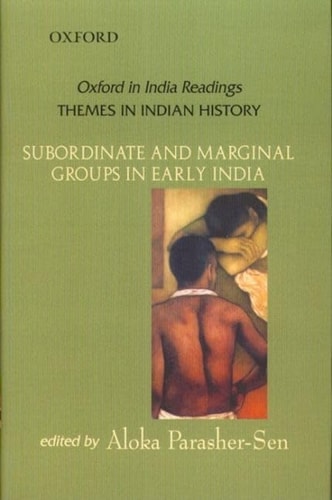
Subordinate and Marginal Groups in Early India
0
0
As an Amazon Associate and affiliate partner, Menrva Books earns from qualifying purchases. Learn more
Author Description
Part of the prestigious Themes in Indian History series, this volume analyzes the historical roots of social oppression and exclusion of the subordinate and marginal groups that have marked the making of identities in the Indian subcontinent. The book highlights how the Indian civilization dealt with problems of diversity and yet did not let go of hierarchical relations. It has contributions from eminent historians like ROmila Thapar, B.D. Cattopadhyaya, Eleanor Zelliot, and Uma Chakrabarty. The introduction by Aloka Parasher-Sen situates the readings in their ideological and histographical contexts.The second edition contains a new Afterword, which traces the historiography till recent times and brings out the shifts and changes in the study of the subject.
Menrva's Summary
THE THESIS
This volume investigates the historical mechanisms of social exclusion and the construction of identity for subordinate and marginal groups within the Indian subcontinent. Aloka Parasher-Sen, an established scholar in Indian history, compiles a series of essays from prominent historians to examine how Indian civilization navigated diversity while maintaining rigid hierarchical structures. The text provides a comprehensive framework for understanding the intersection of social stratification, ideology, and historiography across different periods of Indian history.
THE SCOPE MAP
What You Will Find
- Historical analysis of social oppression and marginalization in early India
- Scholarly contributions from eminent historians including Romila Thapar and Uma Chakrabarty
- Historiographical context regarding the evolution of social identity studies
- A critical examination of the tension between cultural diversity and hierarchical social relations
THE AUTHORITY PERSPECTIVE
Experts recognize this volume as a foundational collection for understanding the complexities of social stratification in South Asian history. Readers frequently note the academic density of the prose and the value of the updated historiographical afterword in the second edition.
Page Count:
486
Publication Date:
2007-11-15
Publisher:
Oxford University Press
ISBN-10:
0195690893
ISBN-13:
9780195690897
History
Social Science
Sociology
India - History
Indian History