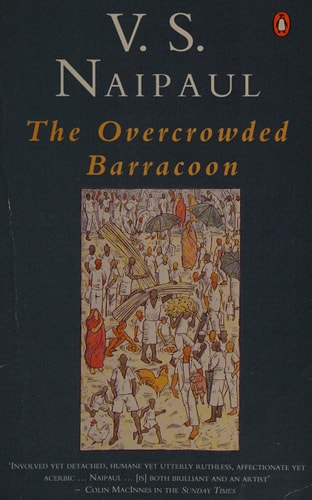
The Overcrowded Barracoon
0
0
As an Amazon Associate and affiliate partner, Menrva Books earns from qualifying purchases. Learn more
Author Description
This 1972 collection of journalistic writings is... truly awesome. In the opening paragraph, Naipual writes, aged just 26, 'I have written three books in five years and made 300 pounds out of them'. Then he explains the doubts and constraints for an aspiring writer from a tiny Carribean island-colony... This is his first printed collection of semi-autobiographic musings about himself and others...Paul Theroux wrote two "biographies"about him, a glowing portrait from Kampala in the 1970s, then a scathing account decades later.... Naipaul is highly present in many of his later books, quite opinionated, some would say prejudiced on almost every creed, race or polity. Being a nice person is helpful when persuing a career in writing. Plenty of evidence suggests that Naipaul was not. Long ago he addressed anl auditorium at an Amsterdam university. At question-time, he was asked his opinion about black people (Africa, Carribean). He left in a huff, heading straight for the airport....And woe the editor who dared change change anything in a manuscript submitted. Naipaul, because of his uphill struggles to become a writer, his early recreational reading of dictionnaries, his life-long interaction with thousands of very different people on five continents, felt he had a right not to suffer fools gladly. He let his light shine on many of today's pertinent issues such as migration, identity and Islam and what caused the Indian subcontinent to become such laggards. Did he decry colonial rule? He surely regretted its legacy...
Menrva's Summary
THE THESIS
This collection investigates the complex intersection of personal identity, colonial legacy, and the socio-political realities of the developing world through the lens of a displaced writer. V.S. Naipaul, a Nobel laureate known for his rigorous and often controversial prose, utilizes his early journalistic output to examine the constraints faced by writers from post-colonial environments. The work serves as a foundational exploration of his evolving perspective on migration, cultural identity, and the lingering effects of imperial rule on the Indian subcontinent and the Caribbean.
THE SCOPE MAP
What You Will Find
- A compilation of journalistic essays and semi-autobiographical musings spanning the author's early career.
- Observations on the economic and social struggles of Caribbean island-colonies.
- Critical analysis of cultural shifts in Africa, India, and the broader post-colonial landscape.
Scope Limits
- The text does not provide a comprehensive history of the regions discussed, focusing instead on the author's subjective experience and specific cultural critiques.
- It excludes the later, more polemical developments in Naipaul's political philosophy found in his subsequent decades of writing.
THE AUTHORITY PERSPECTIVE
Critics and scholars frequently identify this collection as a vital entry point for understanding Naipaul's development as a stylist and social observer. Readers often note the sharp, uncompromising nature of his prose, which reflects both his intellectual rigor and the contentious reputation he maintained throughout his career.
Page Count:
320
Publication Date:
1976-01-01
Publisher:
PENGUIN BOOKS LTD
ISBN-10:
0140041281
ISBN-13:
9780140041286
Autobiography
Essays
Social Commentary
Travel Writing
Journalism
Community Tags
Similar Books