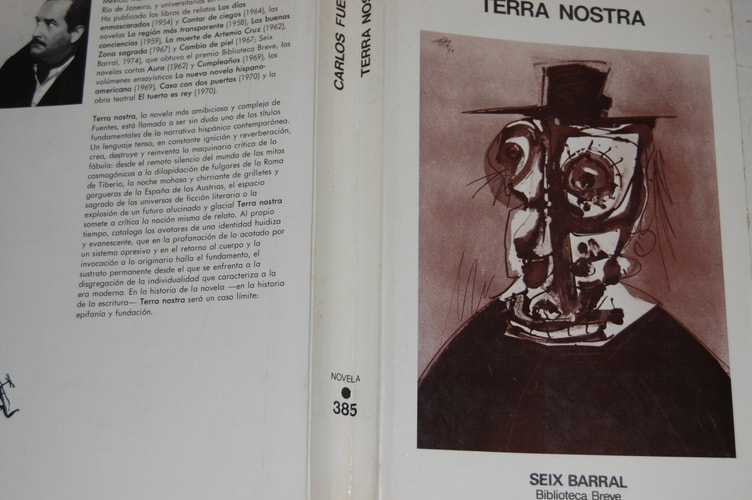
Terra Nostra
0
0
As an Amazon Associate and affiliate partner, Menrva Books earns from qualifying purchases. Learn more
Author Description
One of the great masterpieces of modern Latin American fiction, Terra Nostra is concerned with nothing less than the history of Spain and of South America, with the Indian Gods and with Christianity, with the birth, the passion, and the death of civilizations. Fuentes skillfully blends a wide range of literary forms, stories within stories, Mexican and Spanish myth, and famous literary characters in this novel that is both a historical epic and an apocalyptic vision of modern times. Terra Nostra is that most ambitious and rare of creations – a total work of art.“This extraordinary novel fuses fact and fiction, past and future into one continuum. Centering on Philip II of Spain (Felipe El Senor), chronological time and conventional history are abolished and Fuentes’ Felipe builds El Escorial, marries England's Elizabeth Tudor and witnesses the discovery of the New World.Entwining the miraculous and the fantastic with the grim and grotesque, Terra Nostra stands as a work of sustained allegory and imagination that encapsulates both the New World's future and the decay of Spanish glory.”
Menrva's Summary
THE PULSE
A sprawling, non-linear narrative explores the cyclical nature of history through the eyes of a Spanish monarch obsessed with building a monument to his own legacy. The protagonist, Felipe El Senor, attempts to impose order on a chaotic world by constructing the Escorial, a structure intended to bridge the gap between the divine and the mortal. He faces opposition from the shifting tides of time, the weight of religious dogma, and the inevitable decay of his empire. The narrative framework operates as a complex, multi-layered construction that dissolves the boundaries between the past, present, and future, utilizing a dense, baroque prose style to mirror the complexity of the historical themes.
INSIDE THE PAGES
- Non-linear chronological structure
- Integration of Mexican and Spanish mythology
- Metafictional elements and stories within stories
- Blending of historical figures with surrealist imagery
- Allegorical exploration of colonial history
- Use of grotesque and miraculous motifs
- Philosophical inquiry into the nature of civilization
- Stylistic experimentation with language and form
THE COLLECTIVE ECHO
Discussion often centers on the immense scale of the work and its refusal to adhere to traditional narrative constraints. Readers frequently highlight the challenging nature of the prose, which demands significant attention to navigate the shifting timelines and symbolic density. Critics often point to the novel as a primary example of the Latin American Boom, noting its ambition to encapsulate the entirety of Spanish and American history. The balance of historical detail and fantastical invention creates an atmosphere that is both oppressive and expansive, leaving a lasting impression on those who engage with its complex structure.
Page Count:
891
Publication Date:
1978-01-01
Publisher:
Gallimard
ISBN-10:
0140049223
ISBN-13:
9780140049220
Historical Fiction
History
Fiction
Experimental
Latin American
Epic
Postmodern
Contemporary
Community Tags
Similar Books