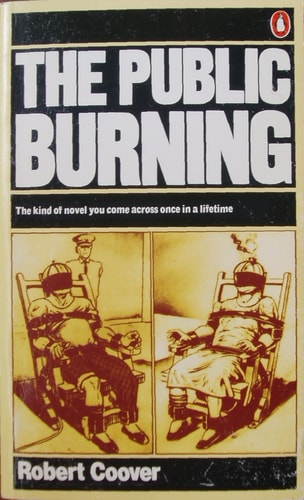
The Public Burning
0
0
As an Amazon Associate and affiliate partner, Menrva Books earns from qualifying purchases. Learn more
Author Description
A controversial best-seller in 1977, The Public Burning has since emerged as one of the most influential novels of our time. The first major work of contemporary fiction ever to use living historical figures as characters, the novel reimagines the three fateful days in 1953 that culminated with the execution of alleged atomic spies Julius and Ethel Rosenberg. Vice-President Richard Nixon - the voraciously ambitious bad boy of the Eisenhower regime - is the dominant narrator in an enormous cast that includes Betty Crocker, Joe McCarthy, the Marx Brothers, Walter Winchell, Uncle Sam, his adversary The Phantom, and Time magazine incarnated as the National Poet Laureate. All of these and thousands more converge in Times Square for the carnivalesque auto-da-fe at which the Rosenbergs are put to death. And not a person present escapes implication in Cold War America's ruthless "public burning."
Menrva's Summary
THE PULSE
The narrative centers on the three days leading up to the 1953 execution of Julius and Ethel Rosenberg, framed through the perspective of a hyper-ambitious Richard Nixon. Nixon serves as the primary narrator, navigating a surreal landscape where historical figures and cultural icons collide in a grotesque spectacle of Cold War paranoia. He struggles to maintain his political standing while contending with the looming execution and the presence of his adversary, The Phantom. The world operates on a logic of heightened satire, where the boundaries between reality, media representation, and national myth dissolve into a chaotic public ritual. The narrative framework utilizes a non-linear, polyphonic structure that incorporates historical documents, news reports, and internal monologues to dissect the American psyche.
INSIDE THE PAGES
- Use of real historical figures as fictionalized characters
- Integration of media archetypes like Uncle Sam and Betty Crocker
- Metafictional commentary on the nature of historical record
- Satirical portrayal of the Eisenhower administration
- Alternating narrative perspectives
- Incorporation of period-specific cultural artifacts
- Carnivalesque atmosphere in Times Square
- Stylized, hyperbolic prose reflecting the political climate
THE COLLECTIVE ECHO
Readers and critics frequently highlight the novel's aggressive satire and its bold decision to blend historical fact with surrealist invention. Discussion often centers on the effectiveness of Richard Nixon as a narrator, with many noting how his voice captures the anxieties and moral compromises of the Cold War era. The pacing is often described as dense and demanding, reflecting the chaotic nature of the events depicted. Many observers point to the book's enduring relevance in discussions regarding political theater and the construction of national identity. The work remains a polarizing entry in contemporary literature due to its uncompromising stylistic choices and its unflinching examination of American power structures.
Page Count:
656
Publication Date:
1979-06-28
Publisher:
Penguin Books Ltd
ISBN-10:
0140048456
ISBN-13:
9780140048452
Historical Fiction
Satire
Metafiction
Political fiction
Cold War