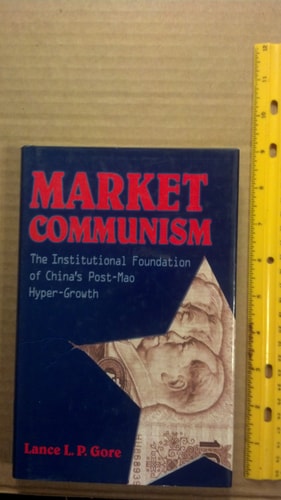
Market Communism: The Institutional Foundation of China's Post-Mao Hyper-Growth
0
0
As an Amazon Associate and affiliate partner, Menrva Books earns from qualifying purchases. Learn more
Author Description
This book explains the paradox that China's rapid economic growth for the past twenty years has taken place in a communist institutional context and under the firm rule of the party-state. In contrast to the dominant explanations of the "Chinese miracle" that feature prominently the marketizing and liberalizing reforms, this book examines the role played by communist institutions and communist cadres in the economic success. With administrative decentralization and the opening of markets within the communist hierarchy, a peculiar institutional hybrid is created, and a new form of economic dynamism-bureaucratic entrepreneurialism-generated. Bureaucratic entrepreneurialism in the Chinese context is the phenomenon of state cadres redirecting communist institutions toward the pursuit of market opportunities. It is an effective growth engine in that it fully utilizes the inherent capacity of the communist system for economic promotion. The institutional context from which it arises also makes it possible for non-economic incentives (notably a top-down political pressure) to be systematically deployed to drive economic expansion. In other words, rapid growth took place not in spite of the persistent communist system but in part because of it. However, although proven a powerful driving force in the economy, bureaucratic entrepreneurialism has helped to preserve the basic structure of the communist system and together with it many of the inherent weaknesses of the Stalinist system. It is effective when the economy is characterized by shortage. Under strong market demand-itself a legacy of the Maoist era "shortage economy"-bureaucratic entrepreneurs, once empowered by decentralization, are extremely effective to mobilize production to meet the still crude, unsophisticated demand. However, once a seller's market turns into a buyer's market, bureaucratic entrepreneurialism runs out of steam. Therefore, sustaining the current strong growth into the future requires a complete o
Menrva's Summary
THE THESIS
This book investigates how the persistence of communist institutional structures and the actions of party cadres facilitated, rather than hindered, China's rapid economic growth during the post-Mao era. Lance L. P. Gore, drawing on extensive research into Chinese administrative and political systems, argues that the unique hybrid of market mechanisms within a communist hierarchy created a specific engine of growth termed 'bureaucratic entrepreneurialism.' The author posits that this system effectively leveraged top-down political incentives to mobilize resources, though he notes that this model faces inherent limitations as the economy transitions from a shortage-driven environment to a more sophisticated buyer's market.
THE SCOPE MAP
What You Will Find
- Analysis of administrative decentralization and its impact on local economic governance.
- The theoretical framework of bureaucratic entrepreneurialism as a driver of industrial production.
- Examination of the transition from a Maoist shortage economy to modern market dynamics.
- Evaluation of the long-term sustainability of party-state economic control.
THE AUTHORITY PERSPECTIVE
Scholars and economists frequently cite this work as a critical counter-narrative to standard liberalization theories regarding China's economic rise. The text is recognized for its academic rigor and its detailed exploration of the institutional mechanisms that define the Chinese political economy.
Page Count:
368
Publication Date:
1999-02-25
Publisher:
Oxford University Press
ISBN-10:
0195907582
ISBN-13:
9780195907582
History
Economics
China
Public Policy
Community Tags
Similar Books