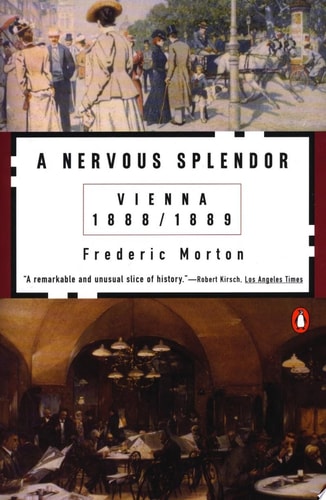
A Nervous Splendor: Vienna 1888-1889
0
0
As an Amazon Associate and affiliate partner, Menrva Books earns from qualifying purchases. Learn more
Author Description
A National Book Award FinalistA "riveting" (New York Times) look at one year of Viennese life during the twilight of an empireOn January 30, 1889, at the champagne-splashed hight of the Viennese Carnival, the handsome and charming Crown Prince Rudolf fired a revolver at his teenaged mistress and then himself. The two shots that rang out at Mayerling in the Vienna Woods echo still.Frederic Morton, author of the bestselling Rothschilds, deftly tells the haunting story of the Prince and his city, where, in the span of only ten months, "the Western dream started to go wrong." In Rudolf's Vienna moved other young men with striking intellectual and artistic talents—and all as frustrated as the Prince. Among them were: young Sigmund Freud, Gustav Mahler, Theodor Herzl, Gustav Klimt, and the playwright Arthur Schnitzler, whose La Ronde was the great erotic drama of the fin de siecle. Morton studies these and other gifted young men, interweaving their fates with that of the doomed Prince and the entire city through to the eve of Easter, just after Rudolf's body is lowered into its permanent sarcophagus and a son named Adolf Hitler is born to Frau Klara Hitler.
Menrva's Summary
THE THESIS
How did the cultural and political atmosphere of Vienna between 1888 and 1889 serve as a catalyst for the decline of the Austro-Hungarian Empire and the birth of modern intellectual movements? Frederic Morton, a historian and biographer known for his work on the Rothschild family, examines the specific ten-month period surrounding the Mayerling incident. He utilizes a biographical and cultural framework to connect the personal tragedy of Crown Prince Rudolf with the emerging ideas of figures like Sigmund Freud, Gustav Mahler, and Theodor Herzl. The text argues that the tensions within this specific year signaled the beginning of the end for the Western imperial dream.
THE SCOPE MAP
What You Will Find
- A detailed account of the Mayerling incident and its impact on the Habsburg monarchy.
- Biographical sketches of key intellectual and artistic figures including Freud, Mahler, Herzl, and Klimt.
- An analysis of the social and political climate of fin de siecle Vienna.
Scope Limits
- The narrative is strictly confined to the events and cultural shifts occurring within the ten-month window of 1888-1889.
- The book does not provide a comprehensive history of the entire Austro-Hungarian Empire beyond the context of this specific year.
THE AUTHORITY PERSPECTIVE
Critics and historians frequently praise the book for its atmospheric prose and its ability to synthesize complex cultural shifts into a readable narrative. Experts often highlight this work as a significant study of the intellectual ferment that defined the end of the nineteenth century in Europe.
Page Count:
352
Publication Date:
1980-10-30
Publisher:
Penguin Books
ISBN-10:
014005667X
ISBN-13:
9780140056679
Biography
History
United States
Royalty
Military
Cultural History
Custom Stores
19th Century
Austrian History
Historical
European History
Leaders & Notable People
Europe
Self Service
Community Tags
Similar Books