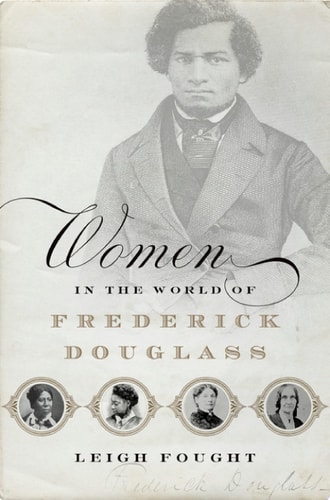
Women in the World of Frederick Douglass
0
0
As an Amazon Associate and affiliate partner, Menrva Books earns from qualifying purchases. Learn more
Author Description
In his extensive writings, Frederick Douglass revealed little about his private life. His famous autobiographies present him overcoming unimaginable trials to gain his freedom and establish his identity-all in service to his public role as an abolitionist. But in both the public and domestic spheres, Douglass relied on a complicated array of relationships with women: white and black, slave-mistresses and family, political collaborators and intellectual companions, wives and daughters. And the great man needed them throughout a turbulent life that was never so linear and self-made as he often wished to portray it.In Women in the World of Frederick Douglass, Leigh Fought illuminates the life of the famed abolitionist off the public stage. She begins with the women he knew during his life as a slave: his mother, from whom he was separated; his grandmother, who raised him; his slave mistresses, including the one who taught him how to read; and his first wife, Anna Murray, a free woman who helped him escape to freedom and managed the household that allowed him to build his career. Fought examines Douglass's varied relationships with white women-including Maria Weston Chapman, Julia Griffiths, Elizabeth Cady Stanton, and Ottilie Assing--who were crucial to the success of his newspapers, were active in the antislavery and women's movements, and promoted his work nationally and internationally. She also considers Douglass's relationship with his daughter Rosetta, who symbolized her parents' middle class prominence but was caught navigating between their public and private worlds. Late in life, Douglass remarried to a white woman, Helen Pitts, who preserved his papers, home, and legacy for history. By examining the circle of women around Frederick Douglass, this work brings these figures into sharper focus and reveals a fuller and more complex image of the self-proclaimed "woman's rights man."
Menrva's Summary
THE THESIS
This work investigates the private life and social network of Frederick Douglass by examining his complex, often overlooked relationships with the women who shaped his personal and professional trajectory. Leigh Fought, a historian specializing in 19th-century American history, utilizes a vast array of primary sources, including private correspondence, public records, and Douglass's own autobiographical writings. She argues that Douglass's public persona as a self-made man obscures a reliance on a diverse circle of women—ranging from family members to political collaborators—who were instrumental in his survival, career, and legacy.
THE SCOPE MAP
What You Will Find
- Analysis of Douglass's relationships with his mother, grandmother, and first wife, Anna Murray.
- Examination of professional partnerships with white female abolitionists like Maria Weston Chapman and Julia Griffiths.
- Exploration of the domestic and social pressures faced by his daughter, Rosetta.
- Documentation of his later marriage to Helen Pitts and her role in preserving his historical papers.
- Methodology involving the reconstruction of domestic spheres to contextualize public political achievements.
Scope Limits
- The text does not provide a comprehensive biography of Douglass's entire political career, focusing instead on his interpersonal dynamics.
- It does not offer an exhaustive history of the women's suffrage movement, only those specific intersections involving Douglass.
THE AUTHORITY PERSPECTIVE
Historians and scholars frequently cite this work for its ability to reframe the narrative of a well-documented historical figure through a gendered lens. Readers note that the prose is accessible yet rigorous, providing a necessary counterpoint to traditional, male-centric biographies of the abolitionist era.
Page Count:
417
Publication Date:
2017-01-01
Publisher:
Oxford University Press
ISBN-10:
019062728X
ISBN-13:
9780190627287
History
Biography
Leaders & Notable People
African American
English
Community & Culture
Historical
Women in History
19th Century
English & College Success
Americas
Biography Autobiography
New Used & Rental Textbooks
World
Womens History
Military
American History
United States
Community Tags
Other Editions(3)
Similar Books
Reader Comments
Share Your Thoughts
No comments yet. Be the first to share your thoughts!