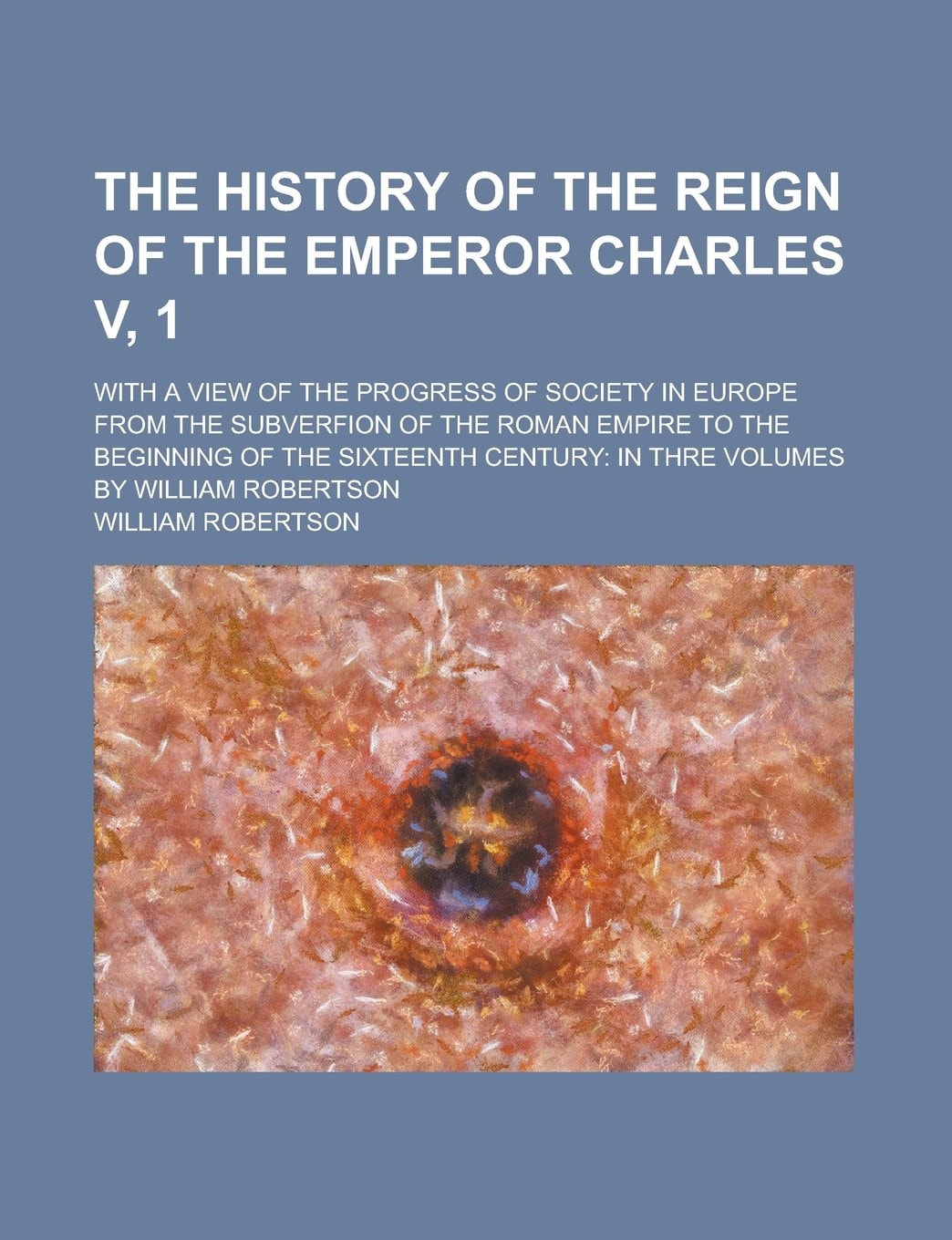
The History of the Reign of the Emperor Charles V, Volume 1: With a View of the Progress of Society in Europe from the Subversion of the Roman Empire to the ... Century
0
0
As an Amazon Associate and affiliate partner, Menrva Books earns from qualifying purchases. Learn more
Author Description
This historic book may have numerous typos and missing text. Purchasers can usually download a free scanned copy of the original book (without typos) from the publisher. Not indexed. Not illustrated. 1769 edition. Excerpt:...1610. ss NOTE VIII. SECT. I. p. 15. H THE history of the establishment and progress of the feudal' system, is an interesting object to all the nations of Europe. Irr some countries, their jurisprudence and laws are still in a great measure feudal. In others, many forms and practices established by custom, or founded on statutes, took their rise from the feudal law, and cannot be understood without attending to the ideas peculiar to it. Several authors of the highest reputation for genius and erudition, have endeavoured to illustrate this subject, but they have left many parts of it Obscure. I shall endeavour to trace, with precision, the progress and variation of ideas con-cerning property in land among the barbarous nations; and shall attempt to point out the causes which. introduced these changes, as well as the effectswhich followed upon them. Property in; land seems to have gone through four successive changes among; the people who scttled in the various provinces of 'the Roman. Empire. I. XVHILE the barbarous nations remained in their original! countries, they had no sixed property' in land, and no certaint limits to their posseffions. After feeding their flocks in onedistrict, they removed' with them, their wives and families, too another; and abandoned that likewise in a short time. were not, in consequence of this imperfect species of property, brought under any positilve or formal' obligation to serve-the; oommunity;; They.-_ community; all their services were purely voluntary. Every individual was at liberty to chuse how far he would contribute towards carrying on any military enterprize. If he followed a leader in any expedition, it was from attachment, not from a sense of obligation. The clearest proof of this has been...
Menrva's Summary
THE THESIS
This work investigates the complex evolution of European society and law from the fall of the Roman Empire through the 18th century, with a particular focus on the establishment and progression of the feudal system. William Robertson, a renowned historian and Principal of the University of Edinburgh, draws upon extensive historical jurisprudence and legal statutes to analyze the changing concepts of land ownership and obligation among the various European nations. The book aims to precisely trace the development of feudal law and its impact on societal structures, offering a detailed examination of property rights and the voluntary nature of early societal services.
THE SCOPE MAP
- A detailed examination of the feudal system's establishment and progress across Europe.
- Analysis of the evolution of property rights in land among migrating European tribes.
- Exploration of the causes and effects of changes in land ownership and legal obligations.
- Discussion of the voluntary nature of services and societal contributions in early European societies.
- Historical context tracing societal progress from the fall of the Roman Empire to the 18th century.
- Insights into the jurisprudence and laws that shaped European legal systems.
THE AUTHORITY PERSPECTIVE
This 1769 edition of William Robertson's seminal work is a foundational text in the study of European history and the development of legal systems. Its detailed examination of the feudal system and societal progress has been influential among scholars for centuries. The book is recognized for its rigorous historical analysis and its attempt to clarify complex legal and social structures. While the provided description notes potential typos in this specific reprint, the original work is esteemed for its scholarly depth and comprehensive scope.
Page Count:
126
Publication Date:
1769-01-01
Publisher:
RareBooksClub.com
ISBN-10:
1236938569
ISBN-13:
9781236938565
Non-Fiction
History
Social History
European History
Community Tags
Similar Books













Reader Comments
Share Your Thoughts
No comments yet. Be the first to share your thoughts!