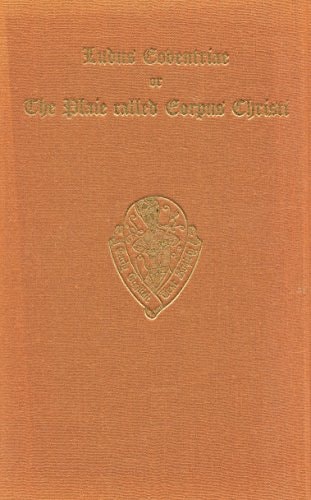
Ludus Coventriae or The Plaie called Corpus Christi: Cotton Vespasian D. VIII
0
0
As an Amazon Associate and affiliate partner, Menrva Books earns from qualifying purchases. Learn more
Author Description
The N-Town Plays (also called the Ludus Coventriae cycle) are a cycle of 42 medieval Mystery plays from between 1450 and 1500. The manuscript is now housed in the British Library, London (MS Cotton Vespasian D. VIII). As its name might suggest, though, it was once the property of the 17th-century antiquarian Sir Robert Bruce Cotton and was housed in his large library. Cotton's librarian, Richard James, quickly examined the manuscript and erroneously assumed that it contained the Biblical plays performed in Coventry during the 15th and 16th centuries, thus naming them the Ludus Coventriae or “the Play Called Corpus Christi”. He was mistaken in both cases, but that mistake has proven very difficult to correct; the name Ludus Coventriae persists in the secondary and critical literature well into the 20th century. The most common way to refer to these plays now is The N-Town Plays, after the reference in the last stanza of the opening proclamation that the play was to be played at “N-Town”; when the plays toured from town to town, (N meaning nomen, the Latin for name) would be replaced by the name of the town the cycle was playing in at any given time. The plays of the N-Town cycle vary from simple, almost liturgical, recitations of Biblical texts (as in the Moses play of the Ten Commandments, the Jesse play with its kings and prophets, and the Penetecost play) to highly complex and fast moving short dramas on Biblical themes that have a naturalism and liveliness (as in the Death of Herod and the Woman Taken in Adultery) almost unique in early drama. These plays can all be played from a wagon or a single booth stage. On the other hand, the two Mary Plays and the Passion Play were written for what is often called “place and scaffold” production in the round using “scaffolds” or raised stages and also the “platea” or the “place” between the stages.
Menrva's Summary
THE PULSE
This collection of forty-two medieval mystery plays presents a comprehensive dramatic cycle centered on the narrative of Corpus Christi. The plays function as a series of interconnected vignettes that move from the creation of the world to the final judgment, utilizing a variety of staging techniques ranging from simple wagon performances to complex, multi-scaffold productions. The narrative framework is primarily didactic and liturgical, designed to convey Biblical history to a medieval audience through both static recitation and dynamic, character-driven drama. The text serves as a primary source for understanding the evolution of early English performance art and the theological priorities of the 15th century.
INSIDE THE PAGES
- Inclusion of the complete 42-play cycle from the Cotton Vespasian D. VIII manuscript.
- Utilization of the 'place and scaffold' production method for complex sequences.
- Integration of liturgical recitations alongside naturalistic, fast-paced dramatic scenes.
- Specific focus on the Mary Plays and the Passion Play as distinct structural units.
- Inclusion of the opening proclamation featuring the 'N-Town' performance convention.
- Exploration of diverse Biblical themes including the Ten Commandments and the life of Herod.
- Evidence of performance flexibility, allowing for both mobile wagon and stationary booth staging.
- Scholarly preservation of the original Middle English text for historical analysis.
THE COLLECTIVE ECHO
Discussion often centers on the historical misidentification of the cycle as the Coventry plays, a naming error that persisted for centuries in academic circles. Readers frequently highlight the stark contrast between the simpler, liturgical segments and the more sophisticated, character-focused dramas like the Woman Taken in Adultery. Critics often examine the staging requirements, noting how the text provides insight into the physical limitations and creative solutions of medieval theater production. The cycle is widely regarded as a foundational artifact for those studying the transition from religious ritual to secular drama in the English tradition.
Page Count:
402
Publication Date:
1970-12-31
Publisher:
Oxford University Press
ISBN-10:
0197225608
ISBN-13:
9780197225608
History
Drama
Religion
Medieval
Literature
Plays