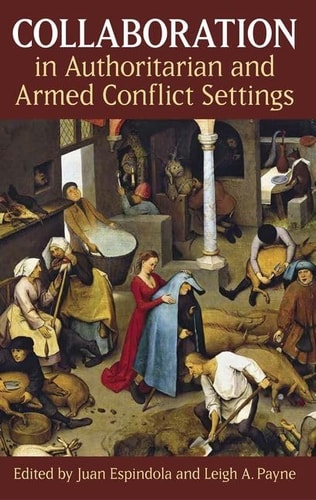
Collaboration in Authoritarian and Armed Conflict Settings
0
0
As an Amazon Associate and affiliate partner, Menrva Books earns from qualifying purchases. Learn more
Author Description
Who is the collaborator, or in whose eyes? What is the motivation to collaborate: for material gain, for ideology, for duty? When is collaboration betraying a hated enemy, and when is it something else: personal revenge or an instrumental, rational, or even coerced response to a situation, for example? Why do collaborators meet such harsh punishment and stigma when they are revealed as such? Can they ever atone or find redemption? Beyond the perception of the stakeholders involved, how harmful is collaboration? Does it exacerbate or abate violence? Is it always evil or can it sometimes be seen as mitigating wrongs? The chapters in Collaboration in Authoritarian and Armed Conflict Settings explore these thorny questions through a set of case studies, disciplinary approaches, and temporal and regional contexts. They show the range of the types of collaboration; the ubiquity of collaboration across time, countries, political systems, and political and cultural conflicts.
Menrva's Summary
THE THESIS
This volume investigates the complex motivations, ethical implications, and social consequences of collaboration within authoritarian regimes and zones of armed conflict. Editors Juan Espindola and Leigh A. Payne assemble a multidisciplinary team of scholars to analyze why individuals cooperate with oppressive forces and how such actions are perceived by society. By examining the spectrum between coerced participation and ideological alignment, the contributors provide a framework for understanding the moral ambiguity inherent in survival and betrayal under duress.
THE SCOPE MAP
What You Will Find
- Comparative analysis of collaboration across diverse temporal and regional contexts.
- Theoretical frameworks for distinguishing between instrumental, ideological, and coerced cooperation.
- Case studies evaluating the impact of collaboration on the escalation or mitigation of violence.
- Examination of the social mechanisms behind post-conflict stigma, punishment, and the potential for atonement.
THE AUTHORITY PERSPECTIVE
Scholars and researchers in the fields of political science and transitional justice view this collection as a rigorous contribution to the study of human behavior in extreme political environments. The text is noted for its academic density and its ability to challenge binary moral interpretations of collaboration in conflict-ridden societies.
Page Count:
294
Publication Date:
2022-10-24
Publisher:
Oxford University Press
ISBN-10:
019726705X
ISBN-13:
9780197267059
History
Human rights
Sociology
Conflict Studies
Community Tags
Similar Books