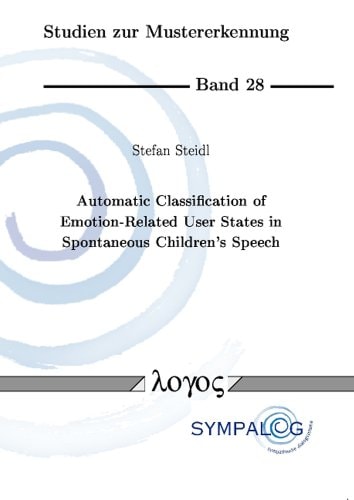
Automatic Classification of Emotion-related User States in Spontaneous Children's Speech
0
0
As an Amazon Associate and affiliate partner, Menrva Books earns from qualifying purchases. Learn more
Author Description
The recognition of the user's emotion-related state is one important step in making human-machine communication more natural. In this work, the focus is set on mono-modal systems with speech as only input channel. Current research has to shift from emotion portrayals to those states that actually appear in application-oriented scenarios. These states are mainly weak emotion-related states and mixtures of different states. The presented FAU Aibo Emotion Corpus is a major contribution in this area. It is a corpus of spontaneous, emotionally colored speech of children at the age of 10 to 13 years interacting with the Sony robot Aibo. 11 emotion-related states are labeled on the word level. Experiments are conducted on three subsets of the corpus on the word, the turn, and the intermediate chunk level. Best results have been obtained on the chunk level where a classwise averaged recognition rate of almost 70% for the 4-class problem 'Anger', 'Emphatic', 'Neutral', and 'Motherese' has been achieved. Applying the proposed entropy based measure for the evaluation of decoders, the performance of the machine classifier on the word level is even slightly better than the one of the average human labeler. The presented set of features covers both acoustic and linguistic features. The linguistic features perform slightly worse than the acoustic features. An improvement can be achieved by combining both knowledge sources. The acoustic features are categorized into prosodic, spectral, and voice quality features. The energy and duration based prosodic features and the spectral MFCC features are the most relevant acoustic features in this scenario. Unigram models and bag-of-words features are the most relevant linguistic features.
Menrva's Summary
THE THESIS
This work investigates the automatic classification of emotion-related user states in spontaneous children's speech, focusing on mono-modal systems using only audio input. The research addresses the need to move beyond idealized emotion portrayals to states that appear in real-world scenarios, such as weak and mixed emotions. It introduces the FAU Aibo Emotion Corpus, a significant dataset of spontaneous, emotionally colored speech from children aged 10-13 interacting with a robot, with 11 emotion-related states labeled at the word level. Experiments were conducted on word, turn, and intermediate chunk levels, achieving a classwise averaged recognition rate of nearly 70% for a 4-class problem on the chunk level.
THE SCOPE MAP
- Introduction of the FAU Aibo Emotion Corpus: a novel dataset of spontaneous children's speech.
- Labeling of 11 emotion-related states at the word level within the corpus.
- Experimental evaluation on word, turn, and intermediate chunk levels.
- Achievement of a ~70% recognition rate for 'Anger', 'Emphatic', 'Neutral', and 'Motherese' on the chunk level.
- Proposal and application of an entropy-based measure for decoder evaluation.
- Analysis of acoustic features (prosodic, spectral, voice quality) and linguistic features (unigram models, bag-of-words).
- Demonstration that acoustic features generally outperform linguistic features.
- Conclusion that combining acoustic and linguistic knowledge sources improves classification performance.
THE AUTHORITY PERSPECTIVE
The research presented in this work focuses on the technical aspects of emotion recognition in children's speech, introducing a novel corpus and experimental methodologies. The findings suggest that machine classifiers can achieve performance comparable to human labelers on specific tasks, particularly when utilizing a combination of acoustic and linguistic features. The study highlights the importance of spontaneous, application-oriented speech data over idealized portrayals for developing more natural human-machine communication systems. The detailed analysis of feature relevance provides a foundation for future advancements in affective computing.
Page Count:
250
Publication Date:
2009-01-01
Publisher:
Logos-Verlag
ISBN-10:
3832521453
ISBN-13:
9783832521455
Non-Fiction
Science
Machine Learning
Corpus linguistics
Speech Recognition
Community Tags
Similar Books