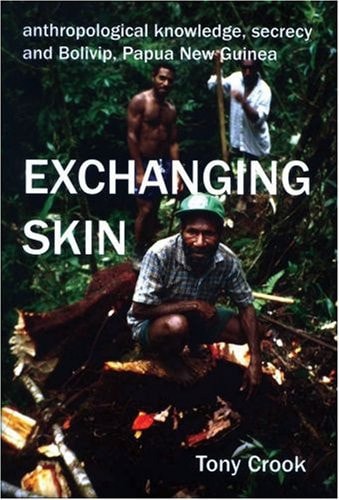
Anthropological Knowledge, Secrecy and Bolivip, Papua New Guinea: Exchanging Skin
0
0
As an Amazon Associate and affiliate partner, Menrva Books earns from qualifying purchases. Learn more
Author Description
The Min peoples of Papua New Guinea are renowned for their secret male initiation rituals and have proven to be one of the most enigmatic cultures in anthropological experience. This study analyses the 'Min problem', and argues that the root of this long-standing interpretative impasse has been in Anthropology's view of secrecy and knowledge.Because Barth's pioneering work in this small corner of Melanesia still exerts an important influence on the discipline's contemporary view of knowledge, the implications of this critique go far beyond a little known problem and raise fundamental questions about the nature of anthropological knowledge itself.In Bolivip, knowledge-making is perceived as exchanging skin and bodily resources with others, and is withheld until a person is capable of bearing it. The argument uses these understandings to consider our own assumptions, and works through alternating chapters. An imagistic ethnography of Bolivip with vivid descriptions of life in the rainforest, supported by high quality illustrations, describes how arboreal and horticultural metaphors motivate the growth of persons and plants. These chapters alternate with ethnographies of anthropological knowledge proposing new readings of Melanesianist texts by Mead, Bateson and Fortune; Weiner and Strathern; and Barth.Having suggested that the root of the Min problem also underpins a wider impasse in anthropological knowledge, the study concludes with a new analytical figure, 'the textual person', that suggests a more promising future for anthropological knowledge.
Menrva's Summary
THE THESIS
This study investigates the 'Min problem' in anthropology, questioning how the discipline's traditional understanding of secrecy and knowledge has created a long-standing interpretative impasse. Tony Crook, drawing on his fieldwork in Bolivip, Papua New Guinea, argues that the Western academic approach to knowledge as a static commodity fails to account for the local Min perspective, where knowledge is treated as a bodily resource exchanged like skin. By contrasting the Min's horticultural and arboreal metaphors for growth with the history of anthropological theory, the author proposes a new analytical framework termed 'the textual person' to reshape how researchers engage with ethnographic data.
THE SCOPE MAP
What You Will Find
- An imagistic ethnography of the Min people, detailing life in the rainforest and local metaphors for human and plant development.
- A critical re-reading of foundational Melanesianist texts by scholars including Mead, Bateson, Fortune, Weiner, Strathern, and Barth.
- A methodological critique of how anthropology conceptualizes secrecy and the transmission of knowledge.
- The introduction of the 'textual person' as a new analytical figure for future anthropological research.
THE AUTHORITY PERSPECTIVE
Experts recognize this work as a significant contribution to Melanesian studies and the reflexive turn in anthropology. Readers frequently note the academic density of the prose, which demands a high level of familiarity with anthropological theory to fully grasp the author's complex arguments regarding knowledge exchange.
Page Count:
230
Publication Date:
2007-11-11
Publisher:
British Academy
ISBN-10:
019726400X
ISBN-13:
9780197264003
Social Science
Knowledge Theory
Anthropology
Ethnography
New Guinea
Community Tags
Similar Books