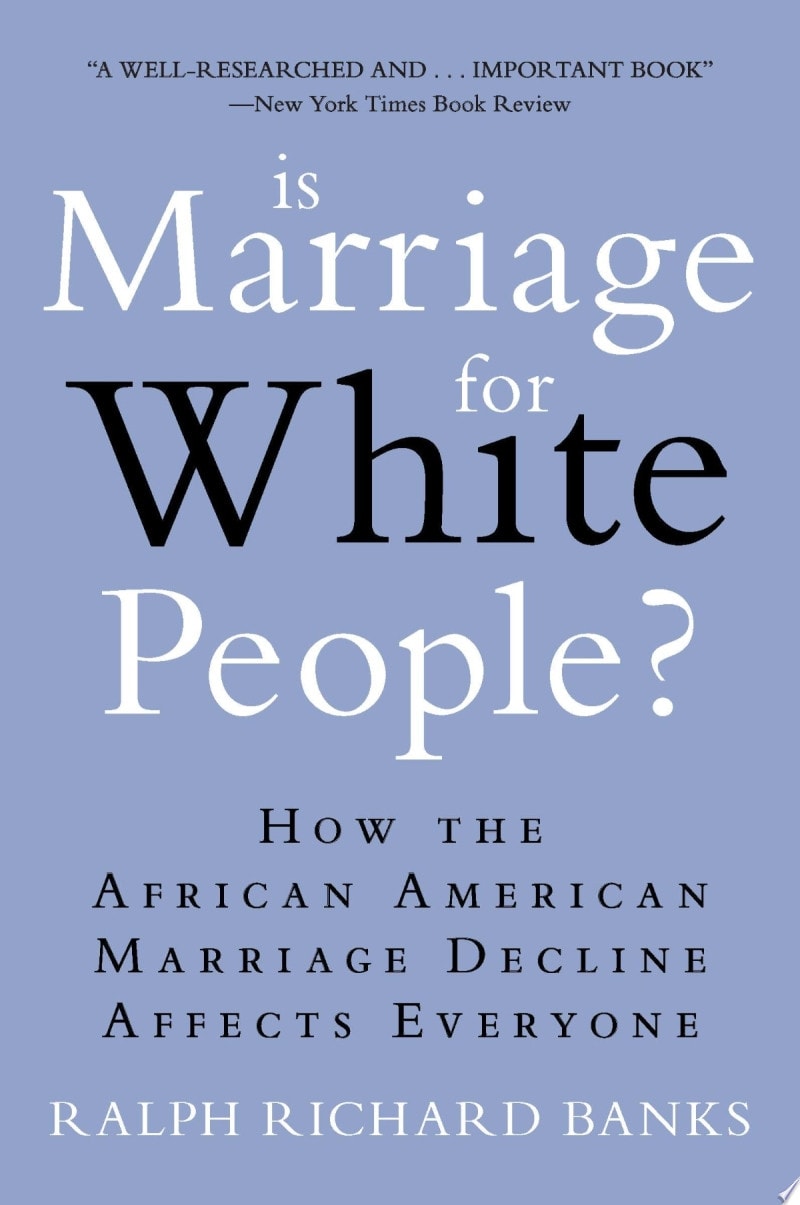
Is Marriage for White People? How the African American Marriage Decline Affects Everyone
0
0
As an Amazon Associate and affiliate partner, Menrva Books earns from qualifying purchases. Learn more
Author Description
A distinguished Stanford law professor examines the steep decline in marriage rates among the African American middle class, and offers a paradoxical-nearly incendiary-solution. Black women are three times as likely as white women to never marry. That sobering statistic reflects a broader reality: African Americans are the most unmarried people in our nation, and contrary to public perception the racial gap in marriage is not confined to women or the poor. Black men, particularly the most successful and affluent, are less likely to marry than their white counterparts. College educated black women are twice as likely as their white peers never to marry. Is Marriage for White People? is the first book to illuminate the many facets of the African American marriage decline and its implications for American society. The book explains the social and economic forces that have undermined marriage for African Americans and that shape everyone's lives. It distills the best available research to trace the black marriage decline's far reaching consequences, including the disproportionate likelihood of abortion, sexually transmitted diseases, single parenthood, same sex relationships, polygamous relationships, and celibacy among black women. This book centers on the experiences not of men or of the poor but of those black women who have surged ahead, even as black men have fallen behind. Theirs is a story that has not been told. Empirical evidence documents its social significance, but its meaning emerges through stories drawn from the lives of women across the nation. Is Marriage for White People? frames the stark predicament that millions of black women now face: marry down or marry out. At the core of the inquiry is a paradox substantiated by evidence and experience alike: If more black women married white men, then more black men and women would marry each other. This book not only sits at the intersection
Menrva's Summary
THE THESIS
The book investigates the significant decline in marriage rates among African Americans, particularly within the middle class, and proposes a controversial solution to address this trend. Ralph Richard Banks, a Stanford law professor, analyzes the social and economic factors contributing to this decline, noting that Black women are three times more likely than white women to never marry, and that successful Black men are less likely to marry than their white counterparts. The book explores the far-reaching consequences of this demographic shift, including impacts on single parenthood, STDs, and relationship choices, focusing on the experiences of Black women who have advanced professionally while facing limited marriage prospects.
THE SCOPE MAP
- Analysis of the social and economic forces undermining marriage for African Americans.
- Examination of the disproportionate likelihood of abortion, STDs, single parenthood, same-sex relationships, polygamous relationships, and celibacy among Black women.
- Focus on the experiences of Black women who have achieved professional success.
- Exploration of the 'marry down or marry out' predicament faced by millions of Black women.
- Presentation of the paradoxical argument that increased intermarriage between Black women and white men could lead to more intra-racial marriages.
- Distillation of the best available research on the black marriage decline.
- Inclusion of personal stories drawn from the lives of women across the nation to illustrate the social significance of the issue.
THE AUTHORITY PERSPECTIVE
The book is recognized for its direct and provocative examination of a critical social issue, offering a unique perspective on the African American marriage decline. Its central thesis, suggesting that increased intermarriage could paradoxically bolster intra-racial marriage rates, has sparked considerable discussion. The work is noted for grounding its analysis in empirical evidence while also incorporating personal narratives to illuminate the experiences of Black women navigating this complex landscape. It is considered a significant contribution to the discourse on race, gender, and family in contemporary America.
Page Count:
304
Publication Date:
2012-09-25
Publisher:
Penguin
ISBN-10:
0452297532
ISBN-13:
9780452297531
History
Non-Fiction
Politics
Race Relations
Demographics
Sociology
Family Studies
Social Science
Community Tags
Other Editions(2)
Similar Books






Reader Comments
Share Your Thoughts
No comments yet. Be the first to share your thoughts!