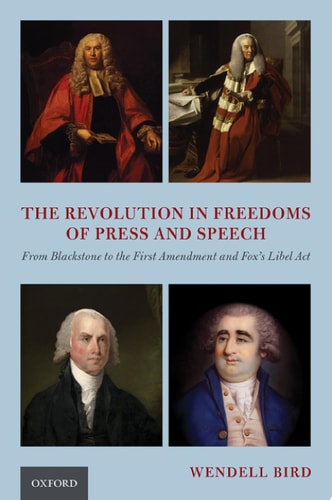
The Revolution in Freedoms of Press and Speech
0
0
As an Amazon Associate and affiliate partner, Menrva Books earns from qualifying purchases. Learn more
Author Description
This Book Discusses The Revolutionary Broadening Of Concepts Of Freedom Of Press And Freedom Of Speech In Great Britain And In America In The Late Eighteenth Century, In The Period That Produced State Declarations Of Rights And Then The First Amendment And Fox's Libel Act. The Conventional View Of The History Of Freedoms Of Press And Speech Is That The Common Law Since Antiquity Defined Those Freedoms Narrowly, And That Sir William Blackstone In 1769, And Lord Chief Justice Mansfield In 1770, Faithfully Summarized The Common Law In Giving A Very Narrow Definition Of Those Freedoms As Mere Liberty From Prior Restraint And Not Liberty From Punishment After Something Was Printed Or Spoken. This Book Proposes, To The Contrary, That Blackstone Carefully Selected The Narrowest Definition That Had Been Suggested In Popular Essays In The Prior Seventy Years, In Order To Oppose The Growing Claims For Much Broader Protections Of Press And Speech. Blackstone Misdescribed His Summary As An Accepted Common Law Definition, Which In Fact Did Not Exist. A Year Later, Mansfield Inserted A Similar Definition Into The Common Law For The First Time, Also Misdescribing It As A Long-accepted Definition, And Soon Misdescribed The Unique Rules For Prosecuting Sedition As Having An Equally Ancient Pedigree. Blackstone And Mansfield Were Not Declaring The Law As It Had Long Been, But Were Leading A Counter-revolution About The Breadth Of Freedoms Of Press And Speech, And Cloaking It As A Summary Of A Narrow Common Law Doctrine That In Fact Was Nonexistent. That Conflict Of Revolutionary View And Counter-revolutionary View Continues Today. For Over A Century, A Neo-blackstonian View Has Been Dominant, Or At Least Very Influential, Among Historians. Contrary To Those Narrow Claims, This Book Concludes That The Broad Understanding Of Freedoms Of Press And Speech Was The Dominant Context Of The First Amendment And Of Fox's Libel Act, And That It Enjoyed Greater Historical Support.
Menrva's Summary
THE THESIS
This book investigates whether the historical understanding of freedom of speech and press in the late eighteenth century was defined by a narrow common law tradition or a broader, more revolutionary concept. Author Wendell R. Bird, a legal scholar, challenges the long-standing Neo-Blackstonian interpretation of legal history. By examining primary sources from the period surrounding the creation of the First Amendment and Fox's Libel Act, Bird argues that figures like Blackstone and Mansfield actively constructed a narrow definition to counter emerging, more expansive views of civil liberties.
THE SCOPE MAP
What You Will Find
- Historical analysis of legal developments in Great Britain and America during the late eighteenth century.
- A critical examination of the writings of Sir William Blackstone and the judicial rulings of Lord Chief Justice Mansfield.
- Evidence derived from state declarations of rights, early libel acts, and contemporary popular essays.
- A re-evaluation of the origins and intended scope of the First Amendment in the United States Constitution.
THE AUTHORITY PERSPECTIVE
Legal historians and scholars of constitutional law recognize this work as a significant challenge to traditional interpretations of First Amendment history. Readers frequently note the academic density of the prose and the extensive reliance on primary source documentation to support the author's revisionist claims.
Page Count:
256
Publication Date:
2020-01-01
Publisher:
Oxford University Press
ISBN-10:
0197509207
ISBN-13:
9780197509203
History
American History
Legal History
Law
Community Tags
Similar Books