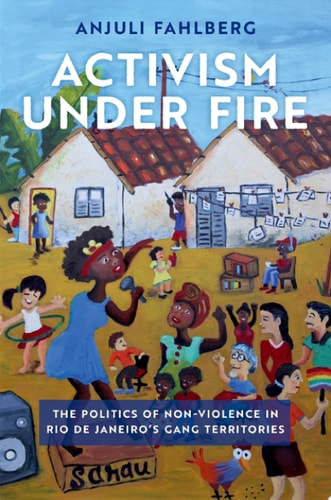
Activism under Fire: The Politics of Non-Violence in Rio de Janeiro's Gang Territories
0
0
As an Amazon Associate and affiliate partner, Menrva Books earns from qualifying purchases. Learn more
Author Description
Rio de Janeiro's favelas have become well-known sites of gang and police violence. Since the 1970s, dangerous networks between drug traffickers and corrupt state actors have transformed these poor neighborhoods into sites of armed conflict and political repression, limiting residents' ability to speak out against violence or demand their democratic rights. Despite these challenges, nonviolent politics remains an integral element in Cidade de Deus--City of God--one of Rio's most dangerous and famous favelas.In Activism under Fire, Anjuli Fahlberg provides an original account of how conflict activism operates in Cidade de Deus. Drawing on fieldwork, virtual ethnography, and participatory action research, Fahlberg documents how activists strategically navigate local constraints and opportunities--including gendered governing dynamics and racialized practices of solidarity--to create space for non-violent governance amid armed repression. By working within urban, national, and transnational political networks and social movements, local activists bring resources into their neighborhood and protest violence while avoiding dangerous alliances.Activism under Fire demonstrates that non-violent collective action is possible amid extreme poverty and violence, and shows what strategies enable it to survive and effect political change. In so doing, Fahlberg reveals the possibilities for collective action in violent and chaotic democratic states, not only in Latin America, but throughout the world.
Menrva's Summary
THE THESIS
How can non-violent collective action persist and effect political change within territories dominated by armed conflict and state repression? Anjuli Fahlberg, a sociologist specializing in urban politics and social movements, investigates the survival strategies of activists in Rio de Janeiro's Cidade de Deus. Utilizing a combination of ethnographic fieldwork, virtual observation, and participatory action research, the book argues that local actors navigate complex power dynamics—including gendered governance and racialized solidarity—to maintain political agency despite the presence of drug traffickers and corrupt state actors.
THE SCOPE MAP
What You Will Find
- Analysis of political activism within the specific context of Rio de Janeiro's favelas.
- Examination of how activists leverage urban, national, and transnational networks to secure resources.
- Methodological insights derived from participatory action research and virtual ethnography.
- Theoretical framework regarding non-violent governance in environments of extreme armed repression.
THE AUTHORITY PERSPECTIVE
Scholars and practitioners in the field of urban sociology recognize this work as a significant contribution to the study of social movements in volatile democratic states. Readers frequently note the depth of the ethnographic detail and the clarity with which the author maps the complex interplay between local activism and broader political structures.
Page Count:
308
Publication Date:
2023-06-06
Publisher:
Oxford University Press
ISBN-10:
0197519326
ISBN-13:
9780197519325
Ethnography
Sociology
Urban Studies
Community Tags
Similar Books